Buyers of data businesses want services and software, because certified platform depth, delivery accelerators and embedded engineers win client work.
Series: M&A activity insights · Last updated: 13 November 2026
The Gist
- Buyers of European data and artificial intelligence (AI) consultancies now cross the line between services and software in both directions.
- International services groups, many of them backed by private equity or listed, buy local data consultancies for certified depth on a major platform and a team in a new country.
- Services groups also buy accelerators, the packaged tools that make a delivery team faster, mainly to win and deliver work more quickly, with ownership of the intellectual property (IP) a secondary reason.
- In May 2026, OpenAI agreed to buy Tomoro, an applied AI consultancy founded in 2023, which OpenAI said would bring about 150 engineers and deployment specialists into its new deployment business.
- Founders of data businesses can strengthen their position with buyers by keeping partner status current and evidenced, and by making sure the company clearly owns its accelerators.
Buyers of data businesses want services and software together because both help them win client work. Services groups buy certified platform depth and accelerators that speed up delivery, and AI companies now buy engineers who get AI into production. International services groups remain the most frequent buyers of European data consultancies, and since May 2026 the AI companies have started buying delivery teams too.
For a founder weighing a sale in the next few years, that changes who to talk to first, and what each buyer will check before making an offer.
Who buys founder-led data businesses in Europe?
The most frequent buyers of European data consultancies are international services groups, many of them backed by private equity or listed. Services groups also buy software tools, and since 2026 AI companies have been buying delivery teams, so a founder-led data business now has three kinds of likely buyer.
Two deals that Mark Sapsford, Co-founder and Partner at CapEQ, and I advised on show the first two routes from opposite sides of the market. In October 2026, Infinite Services, a Polish data and AI consultancy of about 100 people, joined Adastra, the Carlyle-backed AI and data consulting group. Three years earlier, in October 2023, InfiniteData, the Warsaw developer of the AutomateNOW! workload automation platform, joined Beta Systems, the listed German software group. You can read more in our Infinite Services deal announcement and the InfiniteData deal story.
Infinite Services is a people business and InfiniteData is a product business, so on paper the two sit on opposite sides of the market. The European deals announced over the past two years show buyers crossing between those sides, and until recently they crossed mostly in one direction. Services groups bought consultancies for platform depth and bought software tools that help their people deliver faster, while software vendors rarely bought consultancies. In 2026 the AI companies started doing exactly that, and they went for a particular kind of firm.
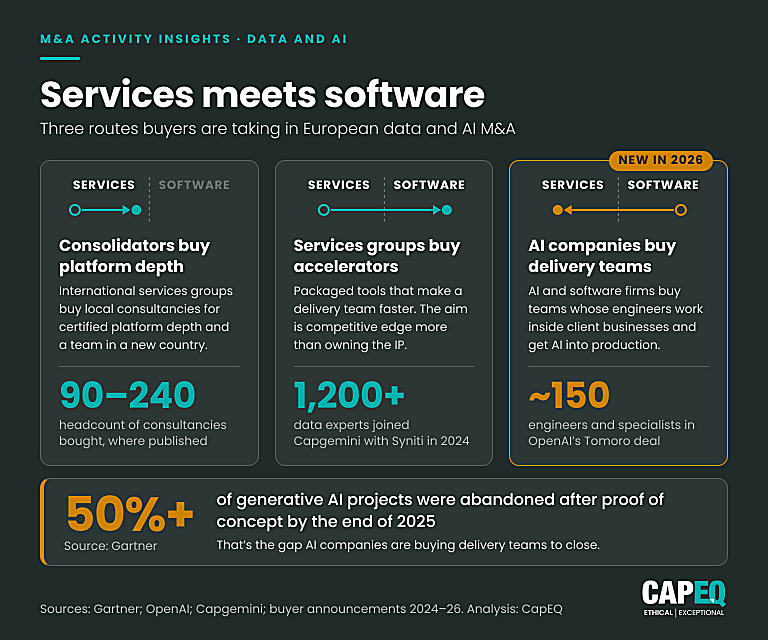
The graphic below sets out the three routes buyers are now taking across the line between services and software, with one sourced figure for each route.
Read more: Why do services groups buy European data consultancies?
Why do services groups buy European data consultancies?
International services groups buy local data consultancies for two things: certified depth on a major data platform, and a team in a new country. Most of these buyers are backed by private equity or listed, and they grow country by country and sector by sector.
Infinite Services is a clear case. Adastra's announcement pointed to its Snowflake Premier Partner status and its award as Snowflake's AI Data Cloud Partner of the Year for Central and Eastern Europe. It also said the deal strengthens Adastra in Poland, one of its key growth markets in Europe.
Infinite Services is not an isolated case, as these announced deals show.
| Announced | Buyer | Data consultancy bought | Based in | What the buyer bought |
|---|---|---|---|---|
| June 2026 | Blend360 | In516ht | Ljubljana, Slovenia | A Snowflake Elite Partner with a team of 90 |
| May 2026 | Eraneos | DEUS | Netherlands | Data and AI capability; about 100 people |
| April 2026 | Accenture | Keepler | Spain | Cloud-native AI and data skills; about 240 people |
| December 2025 | Valcon | Bricobomba | Stockholm, Sweden | Data and AI depth in the Nordics |
| April 2025 | Datatonic | Syntio | Croatia | Data engineering and delivery capacity |
| June 2024 | Accenture | Parsionate | Germany | Data and AI capability in Europe; 130 people |
Where a headcount was published, the consultancies bought had between 90 and 240 people. In almost every announcement, the buyer gives a platform, a partner tier or a country as a reason for the deal.
When I first speak to a potential buyer, the opening questions are always the same: which platforms the firm works on, where it's based, and what kinds of clients it serves, in which countries. Consolidators grow by deepening or widening their platform portfolio, so those answers decide whether the conversation goes any further. Only once they match do buyers ask about skill levels and partner status.
Pro tip from Audrius Sankalas: Before your first conversation with a buyer, put the answers to its opening questions on a single page: the platforms your team is certified on, where your people work, and which sectors and countries your clients are in. A clear page lets the buyer match you to its plans quickly and moves the discussion on to your people and partner status.
Why are services groups buying accelerators and software tools?
Services groups buy software tools, or businesses that combine them with consulting, mainly because a consultancy wins work on how quickly and how well its people deliver. Owning the IP is part of the reason, but competitive edge is the larger part.
Most of the software in question is accelerators, which are tools that do repeatable data work, such as migrating or checking data, faster than a team can by hand. Consultancies used to build them for one client and one job, and nobody treated them as products. Firms now package their accelerators, and some combine them into a suite or a platform. These tools make a delivery team quicker and are rarely sold to end users on their own.
Syniti is the clearest example of this route. Capgemini completed its purchase of Syniti on 3 December 2024, and tied the deal to client demand for complex data migrations. Syniti sells enterprise data management software alongside services for data quality, migration and governance. Capgemini said Syniti brought a global team of more than 1,200 data experts.
In Germany, SNP, which sells both software and consulting for SAP data transformation, bought Datavard, a software and consulting company, and said the two fitted together on both counts. Carlyle completed its takeover of SNP in April 2026.
InfiniteData sits further along the same line. AutomateNOW! is a product in its own right, and Enterprise Management Associates named it a technology leader in its 2023 Radar Report for Workload Automation. Beta Systems said the deal expanded its market position in enterprise automation. It kept the InfiniteData engineering team and has since relaunched the platform as the ANOW! Suite.
Mark Sapsford, who advised on both deals with me, puts it this way:
'Software and consultancy have sat side by side for years, so it's no surprise the deals are following. A buyer looks at a consultancy's tools in one of two ways. Either they help the team sell and deliver faster, or they keep earning after the project ends, because the client carries on running what was installed. The test of whether they're real is simple. Does someone other than the founder use them, on clients the founder doesn't touch, and does the company own them? If the answer lives on one person's laptop, it's a slide in the deck.'
Read more: Are software and AI companies buying data consultancies?
Are software and AI companies buying data consultancies?
Software and AI companies have started buying data consultancies in 2026, with the AI companies moving first. Until this year, software vendors buying consultancies was the least common of the three routes in data.
There are only a few earlier examples in data. Teradata bought UK consultancy Big Data Partnership in 2016 to build its services business across the UK, France, Germany and the Nordics. In 2024, Datavant, a health-data company, bought UK privacy consultancy Trace Data as part of its push into Europe.
The pattern changed in May 2026, when OpenAI launched the OpenAI Deployment Company, backed by more than $4bn from 19 investment firms, consultancies and systems integrators. To staff it from day one, OpenAI agreed to buy Tomoro, an applied AI consultancy founded in 2023 and based in Edinburgh and London. OpenAI said the deal would bring about 150 forward-deployed engineers and deployment specialists into the new company.
In July 2026, the new company agreed to buy Northslope, an applied AI firm founded by former Palantir staff. Ode with Anthropic, the enterprise AI services firm Anthropic set up with Blackstone and Hellman & Friedman, bought Fractional AI in May 2026 and Casper Studios in August 2026. Among data platform vendors, MongoDB said in May 2026 that it had bought Clarity Business Solutions, a services firm that had been one of its partners since 2021.
The reason is the gap between a pilot and production. Gartner research found that by the end of 2025, at least half of generative AI projects had been abandoned after proof of concept. Gartner's analysts point to unclear business value and rising costs among the causes, and closing that gap takes people working inside the client's business as well as better models.
Neither OpenAI nor Anthropic bought a traditional consultancy. Both bought firms built around engineers who sit inside the client's business, work out where AI will pay, and then build it. Others are building their own teams. In June 2026, Databricks formalised a forward deployed engineering organisation, and Amazon Web Services (AWS) committed $1bn to a unit that puts its engineers inside customer teams.
Most software vendors in European data still deliver through partner networks. That is one reason partner status turns up so often in consolidators' announcements, because the partner network is where the delivery capacity sits. Some vendors have now started buying that capacity directly, and MongoDB's purchase of a partner it had worked with since 2021 is the plainest example.
I haven't yet come across a deal in the Nordics, the Baltics or Central and Eastern Europe where an enterprise software company has bought a professional or managed services business. The cases so far are further west, with Tomoro in the UK among them. I'm watching whether they reach those markets, and whether the data platform vendors follow the AI companies.
Mark sets out what this means for UK founders:
'Tomoro is the deal UK founders should notice. It was a young Edinburgh firm, bought for its people: engineers who sit inside a client's business and get AI into production. For a software or AI company, a consultancy like that is a ready-made way to sell and to deliver. What they'll look for in a UK firm is what any buyer of a consultancy looks for: a team that delivers without the founder in the room, and clients who'd stay if the founder didn't.'
Read more: What should a data business founder do before talking to buyers?
What should a data business founder do before talking to buyers?
A data business founder should build for clients first, keep partner status current and evidenced, make accelerators provable and company-owned, and reduce the firm's reliance on the founder. Those steps help a founder reach the buyer who values the firm most, on terms that keep the team and the client base together.
Four things follow, whichever side of the line your business sits on.
- Build for your clients, and the buyers will follow. The things that win you work are the things consolidators ask about, namely certified depth on a major platform and tools that make your team faster. A product business can draw software groups and services groups alike, as InfiniteData went to a software group and Syniti to a services group.
- Treat your partner status as evidence of what the firm can deliver. It's rarely a buyer's first question, but buyers check it and quote it in their own announcements, so keep it current, documented and backed by named, certified people.
- If you've built accelerators, make them provable. A buyer will want to see who uses them, what they save, and whether they work without your founding team in the room.
- If your team takes AI from pilot into production, there's a new kind of buyer. The AI companies have shown they'll buy firms whose engineers work inside client teams, and Tomoro shows that includes UK firms.
If you want your accelerators to count when you sell, make them assets of the company. That starts with clear IP and clear ownership, and the more productised the tools are, the better, which applies equally to proprietary frameworks and automation tools.
We would rather tell a founder to wait than take a firm to market before its tools and client relationships can be evidenced, because a buyer will find the gaps in diligence and price them. Our guide to how CapEQ runs a business sale explains the process once the groundwork is done.
Mark's advice to UK founders is about timing:
'Start 18 months to two years out, and get yourself out of the client relationships first. In a data consultancy the platform badges are easy to check. What a buyer can't see on paper is whether the clients belong to the firm or to you. Put a second senior person on every major client and let the team win work without you. Where a client still runs software you put in, get the support onto a contract. Buyers can tell the difference between a relationship that's been handed over and one that's only been described as handed over.'
What do buyers check in a data business before they buy?
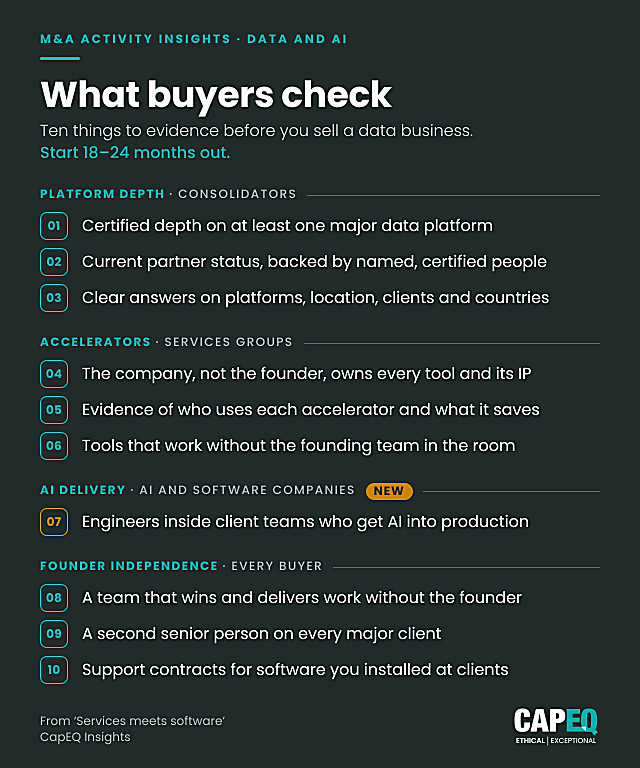
Buyers check ten things in a data business, grouped by who is asking: consolidators, services groups, AI companies and every buyer. Start evidencing them 18 months to two years before a sale, because several take that long to show.
- Certified depth on at least one major data platform.
- Current partner status, backed by named, certified people.
- Clear answers on platforms, location, clients and countries.
- The company, not the founder, owns every tool and its IP.
- Evidence of who uses each accelerator and what it saves.
- Tools that work without the founding team in the room.
- Engineers inside client teams who get AI into production.
- A team that wins and delivers work without the founder.
- A second senior person on every major client.
- Support contracts for software you installed at clients.
Items one to three are what consolidators test first, items four to six matter most to services groups buying accelerators, and item seven is what the AI companies are buying. Items eight to ten apply to every buyer, and they take longest to put in place.
Frequently asked questions
Who buys data and AI consultancies in Europe?
Most often, international services groups that want platform depth and a presence in new countries, many of them backed by private equity or listed. Recent examples include Adastra buying Infinite Services in Poland, Blend360 buying In516ht in Slovenia, and Accenture buying Keepler in Spain. Services groups also buy software and tooling businesses, as Capgemini did with Syniti. Since May 2026, AI companies have started buying delivery teams too, although we have not yet seen one buy in the Nordics, the Baltics or Central and Eastern Europe.
Why do buyers care about platform partner status?
Partner status is evidence of certified delivery capacity on a platform the buyer's clients already use. Buyers quote partner tiers in their own deal announcements. In our experience it is rarely the opening question, which is usually about platforms, location and clients, but buyers check it once those match. Status that is current, documented and backed by named, certified people is the easiest to verify.
What is an accelerator, and does it matter in a sale?
An accelerator is a tool that does repeatable data work, such as migrating or checking data, faster than a team can by hand. Consultancies used to build them for one client and one job, and more firms now package them as products or combine them into a suite. A buyer values accelerators as delivery speed. For them to count in a sale, the company has to own them clearly, and the more productised they are, the better.
Are software companies buying consultancies now?
Software companies are buying consultancies more often than before, with the AI companies moving first in 2026. Software vendors have mostly delivered through partner networks, and earlier examples in data are few: Teradata bought Big Data Partnership in 2016 and Datavant bought Trace Data in 2024. In 2026, OpenAI and Ode with Anthropic began buying delivery teams directly, and MongoDB bought Clarity Business Solutions, which had been its partner since 2021.
What kind of firm are the AI companies buying?
The AI companies are buying applied AI firms built around engineers who work inside the client's business and take AI from pilot into production. OpenAI said Tomoro would bring about 150 forward-deployed engineers and deployment specialists to its deployment business, and Northslope was founded by former Palantir staff. Neither OpenAI nor Anthropic bought a traditional consultancy. Gartner research found that by the end of 2025, at least half of generative AI projects had been abandoned after proof of concept.
When should a data business founder start preparing for a sale?
A data business founder should start preparing 18 months to two years before a sale. That gives time to fix what a buyer would question, from evidencing partner status to settling who owns the firm's accelerators. In a consultancy, reducing the business's reliance on the founder usually takes 12 to 24 months, as Mark Sapsford sets out in his guide to reducing founder dependency in a consultancy.
For a closer look at what buyers pay a premium for in enterprise software, including the InfiniteData sale, read our UK & European ERP Software M&A Report 2026.
About the author
Audrius Sankalas is a Partner at CapEQ, based in Lithuania. Since joining the industry in 2011, he has overseen M&A and corporate finance work across Lithuania, the Baltic states and Scandinavia, and advised boards in manufacturing, travel, hospitality and pharma. Before advising, he ran a metal trading company and a pape
r merchant, and built his own import-export agency and consultancy. He co-led the sale of Infinite Services to Adastra with Mark Sapsford and worked with Mark on the sale of InfiniteData to Beta Systems. His other transactions include the sales of PPMI Group to Kantar Public and UAB Selteka to Inission AB. CapEQ is a UK-headquartered, partner-led M&A advisory boutique that helps founders of independent businesses sell, typically at enterprise values of £10m–£50m. As a member of Fusio Global Advisors, CapEQ works alongside independent partner firms in Germany, the Netherlands, Poland, and Spain.
-
Meet Audrius or have a no-pressure conversation with him.
-
Mark Sapsford, Co-founder and Partner at CapEQ, contributed to this article. Read Mark's profile or have a no-pressure conversation with Mark.
Related insights
- M&A activity insights: more CapEQ analysis of who is buying and why
- How to reduce founder dependency in a consultancy: Mark Sapsford's seven moves for making a consultancy's revenue transferable
- How to find the right acquirer for your business: running a disciplined, competitive search for the right buyer
- How to handle an unsolicited offer to buy your business: what to do if a consolidator or an AI company calls first
- Beta Systems acquires InfiniteData: the product side of this article, a Warsaw software business sold to a listed German software group
Sources
- Consultancy.eu: Adastra acquires Infinite Services
- Beta Systems acquires InfiniteData (MarketScreener)
- Blend360 acquires In516ht (PR Newswire)
- Eraneos acquires DEUS (Consultancy.eu)
- Accenture acquires Keepler (Consultancy.eu)
- Valcon acquires Bricobomba (PrivSource)
- Datatonic acquires Syntio
- Accenture completes acquisition of Parsionate
- Capgemini announces the closing of the acquisition of Syniti
- SNP acquires Datavard (ChannelE2E)
- Carlyle takes SNP private (PrivSource)
- Teradata acquires Big Data Partnership (SiliconANGLE)
- Datavant acquires Trace Data
- OpenAI launches the OpenAI Deployment Company
- Axios: OpenAI deployment arm to acquire Northslope
- Fractional AI acquisition announcement
- Ode with Anthropic acquires Casper Studios (Business Wire)
- MongoDB first quarter fiscal 2027 results
- Gartner: why 50% of GenAI projects fail (Computer Weekly)
- Databricks: forward deployed engineering
- IT Brief UK: AWS commits $1bn to embedded AI engineers