Discover the CapEQ approach to a premium exit
Whether you're exploring your options or fending off offers, we're here to help.

In a consultancy the value walks out with you; here are seven ways to make founder-led revenue transferable before sale.
Series: Getting exit-ready · Last updated: September 2026
Written by Mark Sapsford, Partner at CapEQ | Originally published: September 2026
The Gist
- In a consultancy, founder dependency has a particular shape: it lives in who owns the client relationship and who wins the work, not just who runs operations.
- The test a buyer applies is simple – can the firm win a £100,000 client, and keep an existing one, without the founder in the room? If not, the value is a job, not an asset.
- Rainmaker dependency – where new revenue relies on the founder's personal network and selling – is the hardest form of dependency to transfer, and the most common in professional services.
- Converting project work into retainers, frameworks and managed services creates revenue that belongs to the firm rather than to the founder's next win.
- The credible reduction work takes 12 to 24 months; buyers can tell the difference between a relationship that has been transferred and one that has merely been described as transferred.
- The end state worth aiming for: the founder can step out for six weeks, revenue holds, clients stay calm, and new work still arrives.
Most owner-managed businesses depend on their founder to some degree. We cover the general case – what dependency is, why it quietly costs you long before any sale, and the ten things any owner can do about it – in our guide to reducing business owner dependency. This piece is for a specific kind of founder: the one who runs a consultancy, agency or professional-services firm.
In those businesses, dependency takes a particular and stubborn form. It rarely sits in machinery or stock. It sits in two places: who owns the client relationship, and who wins the work. Both, very often, are you.
That is the thing a buyer is trying to price. So the goal of the work below is not simply to make you busier, or less busy. It is to make a buyer believe the firm will keep producing revenue, serving clients and making decisions without you as the irreplaceable ingredient.
When an acquirer looks at a professional-services firm, they are testing for transferable goodwill – the value that stays with the business when the founder leaves, rather than walking out of the door with them. In consultancies this goodwill is unusually mobile, because it lives in relationships and reputations rather than in assets you can put on a balance sheet.
Two forms of dependency do most of the damage. The first is client dependency: the client works with you, not with the firm. The second is rainmaker dependency – the reduction in transferable value that applies when new revenue relies on the founder's personal network, credibility and selling. Rainmaker dependency is the harder of the two to fix, because it is the one founders are least willing to hand over.
A single question sorts most consultancies quickly. Can your team win a £100,000 client, and renew an existing one, without you being the person who closes it? If the honest answer is no, that is the first thing to fix – and it is the difference a buyer will feel most sharply in diligence.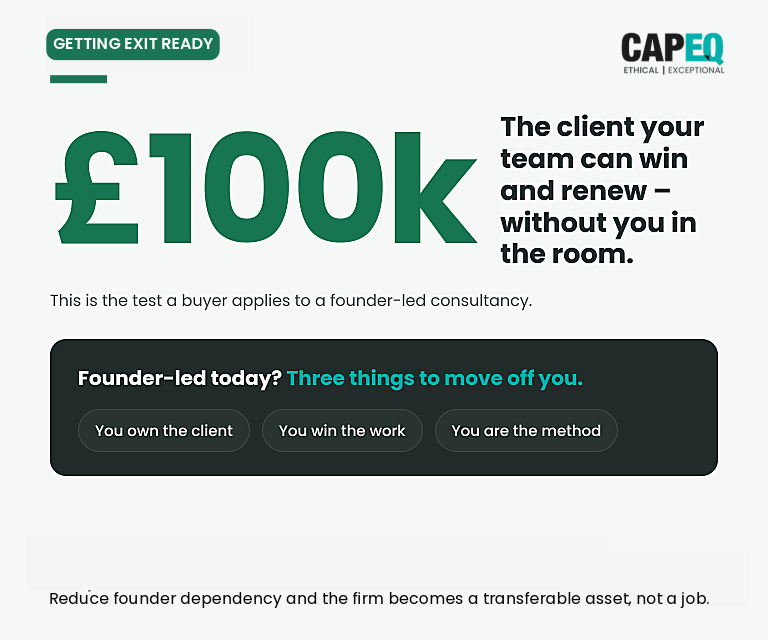
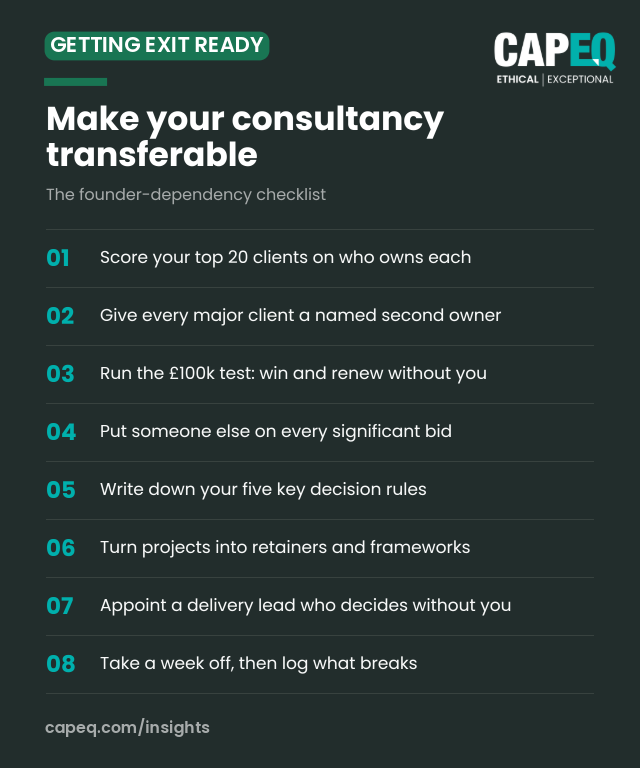
None of these is complicated. What they take is time and the discipline to stop rescuing the business every time it wobbles. Done properly, the sequence usually runs over 12 to 24 months, and it produces a firm that is both more sellable and considerably more pleasant to own in the meantime.
Work through them roughly in order. The early moves make the later ones possible.
List your top 20 clients and score each one honestly. Who owns the relationship? Who sells the additional work? Who runs the meetings? Who does the client call when something breaks? Would the client stay if you vanished tomorrow?
Then introduce a second relationship owner for every important client. At first you attend meetings together. Then they lead and you attend. Eventually you stop attending. The aim is for the client to think "I work with the firm, and Priya is my contact" rather than "I work with the founder." That shift is one of the clearest ways to demonstrate transferable goodwill, and buyers will test it by asking the client directly.
If your methodology lives in your head, you are the product. Write down how you diagnose a client problem, your frameworks, your pricing logic, your proposal and project templates, your delivery checklists and your quality control. Do the same for onboarding, reporting and the awkward problems that recur.
Do not aim for a 300-page manual nobody opens. Build playbooks people actually use. The test is simple: a buyer should be able to ask "how does this firm deliver X?" and get an answer that is not "ask the founder."
You want three distinct functions – you, a leadership tier, and the consultants who serve clients – rather than a structure where every line runs back through you. Depending on your size, that might mean a delivery or operations lead, one or two client directors, and someone who owns finance and admin.
You do not need a large management team. You need to show that someone other than you can make a sensible decision without waiting for your approval. Management depth is one of the specific things buyers examine in professional-services deals, and it is hard to fake late in the day.
This is the big one for consultancies, and the one founders resist most. For every significant opportunity, put somebody else into discovery, proposal, pitch, negotiation and close. You can still help on major bids. What you are building is evidence that the firm can generate revenue without your personal network doing the heavy lifting.
Rainmaker dependency is quietly fatal to value because it cannot be documented away – you cannot write a playbook for being liked and trusted after twenty years. The only fix is to give other people real ownership of winning work, and to let them win some without you in the room.
Pro tip from Mark Sapsford: "The question I ask consultancy founders is blunt – if you were knocked off your bike tomorrow, whose phone rings? If it is still yours, we have work to do. The firms that command the best terms are the ones where the founder could disappear for a season and the pipeline would not notice."
Where it makes commercial sense, convert some project work into retainers, framework agreements, annual advisory contracts, managed services or ongoing support. The point is not to manufacture a "recurring revenue" label to wave at a buyer – they see through that. It is to create predictable revenue that belongs to the firm rather than to your ability to win the next project.
Buyers generally find contracted or repeat revenue easier to underwrite than purely project-based income, because they can model it with more confidence. That tends to widen the buyer pool and support a cleaner deal structure, weighted towards cash at completion rather than deferred earn-outs.
Look at revenue by client, not just in total. If one client provides, say, 30% of revenue and that relationship exists mainly because of you, you have two dependencies stacked on top of each other. You do not necessarily fire the big client. You grow the rest of the base, introduce other people into the large account, broaden the firm's relationships inside it, and get the arrangements documented properly.
Concentration and the transferability of client relationships are examined closely in diligence. A big, founder-owned account is read as a big, founder-owned risk – however good the work.
This is the most useful practical exercise, and the cheapest. Start with one week. Tell the team you are unavailable for normal operational matters, and then do not rescue them. Record every moment someone says "we need you to decide," "the client wants to speak to you," "how do we normally do this?" or "what did you promise them?"
Those are not annoyances. They are your exit-preparation backlog. Fix the underlying causes, then repeat at two weeks, then four. Track the pattern month to month on a simple founder-dependency scorecard – the direction of travel matters more than any single number, and it is exactly the evidence a buyer wants to see.
A business sale in Mark's back catalogue brings this home. Mark advised JGA Fire, a fire-engineering consultancy, on its sale to Jensen Hughes. The value had to be shown as genuinely transferable – client relationships that would survive a change of ownership, and delivery that did not depend on a single individual.
The lesson from this is that where a firm can demonstrate that its clients belong to the business and its work can be delivered by the team, it is treated as a transferable cash flow and attracts a competitive process.
Where it cannot, the conversation turns quickly to earn-outs, retention and lock-ins – the buyer protecting itself against the risk that the person they are really buying might leave.
Do not disappear overnight the month before you sell. Buyers want proof the business works without you, but they also want a credible handover. A defined transition reduces perceived risk rather than raising it.
| Stage | Your role | The team's role |
|---|---|---|
| Now | Client owner, rainmaker and senior delivery | Support you |
| Phase 1 (0–6 months) | Senior relationship owner | Take on more delivery |
| Phase 2 (6–12 months) | Strategic relationships and major bids only | Own clients and delivery |
| Phase 3 (12–18 months) | Chair-style, strategic input | Run the day-to-day |
| Pre-sale | Mostly external and strategic | Run the firm |
| Post-sale | Agreed, time-boxed handover | Buyer and management run it |
Measure a small number of things every month. You are looking for steady movement in the right direction, not perfection.
| What to measure monthly | Direction before sale |
|---|---|
| Revenue where you are the primary relationship owner | Down |
| Revenue you personally deliver | Down |
| New business that needs you to close it | Down |
| Key clients with a named second relationship owner | Towards 100% |
| Core processes documented | Towards 100% |
| Recurring or contracted revenue | Up |
| Client concentration (largest client as a share of revenue) | Down |
| Decisions made without you | Up |
The compelling end state is straightforward to describe and hard to fake: you can take six weeks off, revenue does not materially dip, clients do not panic, the team knows what to do, and new business still arrives.
At that point you are no longer selling your job as a consultant. You are selling an organisation that happens to have been built by you.
If you think your consultancy has addressed most of these and is in good shape, it's time to start your business sale journey here.
A practical summary you can start this quarter, whether or not a sale is on the horizon.
Sometimes, but the terms will reflect the dependency, and a severely founder-dependent consultancy may not attract a buyer at all. Where a deal is achievable, acquirers typically defer a larger share of the consideration into earn-outs, hold back retention payments over several years, and require an extended handover – all to protect themselves against the risk that the person they are really buying might leave. Founders who go to market without first reducing dependency often complete on significantly worse terms than they expected, or watch initial offers soften during diligence. The purpose of the preparation is not to squeeze the last pound out of a sale; it is to give you the option to leave well, on a clean structure, rather than being locked back into the business you were trying to exit.
Rainmaker dependency is the reduction in a firm's transferable value that applies when new revenue relies on the founder's personal network, reputation and selling rather than on a repeatable, team-owned sales process. It is the most common and most stubborn form of dependency in professional services, because relationships and credibility built over decades cannot simply be documented and handed over. A buyer assessing a consultancy will look hard at where the pipeline comes from: if the answer is "the founder," they will price the risk that the pipeline leaves when the founder does. Reducing it means giving other people genuine ownership of winning work, and being able to show they have won some without you in the room.
You transfer them, methodically, over a period of months rather than weeks. For each important client, introduce a second relationship owner, attend meetings together at first, then hand over the lead while you step back, and finally stop attending. Buyers can tell the difference between a relationship that has genuinely been transferred and one that has merely been described as transferred – they will ask the client whom they deal with. Start with the clients that represent the greatest concentration of revenue, because those are the ones a buyer will scrutinise first. The work rarely happens on its own; it happens because someone made a plan and sequenced the introductions.
Meaningful reduction typically takes 12 to 24 months, and longer where the founder's client relationships run especially deep. It cannot be credibly compressed into the final months before going to market, because buyers can see the difference between responsibility that has genuinely moved and responsibility that has recently been relabelled. CapEQ generally advises founders to begin the dependency work 18 to 24 months before any intended exit, alongside broader exit-readiness preparation. Starting early also means you enjoy the day-to-day benefit – a firm that runs without you constantly present – long before any sale.
Buyers generally find contracted or repeat revenue easier to underwrite than one-off project income, because it is more predictable and less tied to the founder's next win. That tends to support both a wider buyer pool and a cleaner deal structure, weighted towards cash at completion. The point of building it is not to manufacture a "recurring revenue" label for valuation purposes – buyers see through that quickly – but to create revenue that genuinely belongs to the firm. Retainers, framework agreements and managed services all move income away from the founder's personal ability to win the next project and towards something a new owner can rely on.
The £100k client test is a simple diagnostic for founder dependency in a consultancy: can your team win a significant new client, and renew an existing one of similar value, without you being the person who closes the deal? If they can, you have demonstrable evidence that the firm generates revenue rather than that you do – which is exactly what a buyer needs to see. If they cannot, it points directly to rainmaker dependency, and it is usually the first thing worth fixing. The specific figure matters less than the principle: significant revenue should be winnable and defensible without the founder in the room.
 Mark Sapsford is a Co-founder and Partner at CapEQ. He served in the RAF before building a career in energy and recruitment, and was part of the management team that personally sold an executive search & reruitment business – so he has sat on the founder's side of a transaction as well as the adviser's. Mark has personally led 51+ completed deals and overseen 115+ across CapEQ's history, with particular experience in energy, recruitment, engineering and tech, and the wider UK mid-market.