Discover the CapEQ approach to a premium exit
Whether you're exploring your options or fending off offers, we're here to help.

Feeling trapped by your own business? Owner dependency can cost founders 20–40% of their exit price — if they are sellable at all. Here is how to break free.
Series: Getting exit-ready · Last updated: May 2026
- Owner-dependent UK businesses achieve 20–40% lower valuations at exit than comparable companies where the founder is not central to day-to-day operations.
- The "key-man discount" — the formal reduction buyers apply when one person is central to a business's performance — ranges from 10% to 50% of enterprise value depending on severity.
- Roughly 80% of UK private companies never sell; owner dependency is one of the most commonly cited structural barriers.
- Feeling trapped is not a personal failing — it is an operational design problem with practical, addressable solutions.
- Selling can be the most effective route to freedom for founders who have tried everything else; it is a legitimate strategic choice, not a last resort.
- CapEQ has completed 115+ transactions across the UK mid-market. The pattern is consistent: founders who build independence before going to market achieve materially better outcomes.
You started your business to create freedom. Somewhere between the first client and the hundredth, freedom quietly became something you have to earn back.
If you find yourself answering emails at 10pm, unable to take a proper holiday without the phone ringing, or realising that the business genuinely could not function without you for a fortnight — you are not alone, and you are not weak. You have built something that depends on you, and that is an incredibly common outcome of building a business the hard way.
But here is the thing most advisers leave unsaid: being trapped inside your business is not just a wellbeing problem. It is a valuation problem.
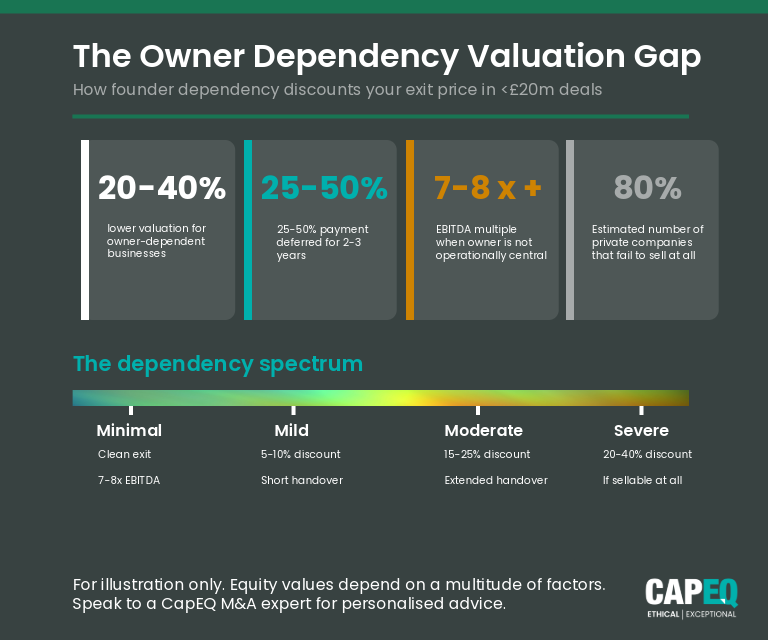
Owner dependency is one of the most reliably value-destructive factors in the UK mid-market. Analysis published in early 2026 found that owner-dependent businesses achieve 20–40% lower valuations than comparable companies where the founder is not operationally central. Research across M&A transactions shows that founder-dependent companies exit at 3–4x EBITDA multiples, while owner-independent businesses regularly command 7–8x or higher.
That gap is not about the quality of your product or your customer relationships. It is about perceived risk — and perceived risk is something you can address.
Before you can solve the problem, it is worth being honest about what it is. These patterns tend to appear gradually, which makes them easy to normalise.
You are making decisions that should not require you. If your team regularly asks what you would want before acting on routine matters — staffing rotas, supplier queries, client complaints — that is a sign that authority has not been properly distributed.
Key relationships are personal to you, not to the business. Your best clients trust you specifically. If you left tomorrow, they might leave too. Buyers price that risk directly into their offers.
Revenue depends on your hours. If your profitability is structurally tied to you working 50+ hours a week, the business is not scalable in any meaningful sense. A buyer will know this within days of reviewing your management accounts.
You cannot take a real break. The classic test: could the business run for four weeks without you? If the honest answer is no, you have identified the problem.
According to data published by Virgin StartUp, 51% of UK startup founders report experiencing burnout, with almost one in five saying their mental health has worsened over a six-month period. The problem is widespread — but its commercial consequences are rarely discussed.
These are not new ideas. But the reason to act on them has changed: the goal is not just personal wellbeing — it is making your business transferable, and that makes it more valuable.
The distinction matters. Delegating a task means handing off a to-do item. Delegating authority means giving someone decision-making power within a defined scope, and trusting them to exercise it.
Start with the decisions you make most often that require the least specialist judgement. Operational decisions — scheduling, routine procurement, standard client communications — should rarely need to reach you. Document the criteria for those decisions, brief the right people, and step back.
It will feel uncomfortable. Do it anyway.
Modern CRM, invoicing, payroll, and project-management platforms exist precisely to eliminate the manual work that keeps founders unnecessarily involved. If you are still doing manual follow-up emails, chasing invoices by hand, or running payroll yourself, you are consuming time that could be better spent — and creating operational fragility that buyers will identify.
Automation is not about replacing people. It is about replacing unnecessary founder involvement in processes that have a logical, repeatable structure.
This is the hard one, and often the most valuable. If there is no second tier of management between you and the day-to-day operation of the business, the company is entirely dependent on your presence and judgement.
For businesses planning an exit in the next two to four years, building a credible senior management team is often the single highest-return investment available. A business that can run and grow without the founder does not just sell more easily — it sells for more.
Re-evaluate which revenue streams require the most of you personally. Service businesses where the founder is effectively the product — relied on for delivery, not just for strategy — have a structural problem that delegation alone cannot fix. Ask whether your model could include more scalable income: retainers, licensing, subscriptions, or productised services that generate revenue without demanding your time in the same direct way.
Many founders struggle with this one because it feels like letting clients or colleagues down. It is not. Establishing that you are available during defined hours, and that certain decisions go through specific people, actually builds confidence in the business's resilience. Clients who understand that the company can serve them without you personally are more likely to stay post-transition — which matters to every buyer.
Pro tip from Mark Sapsford: The fastest way to test whether you have an owner dependency problem is to plan a two-week holiday and try to actually take it.
If you cannot get to the airport without fielding calls, or the holiday becomes a working holiday in a warmer location, you have answered your own question. That test is also exactly what a sophisticated buyer will run mentally when they assess your business.
Understanding precisely how buyers translate owner dependency into price adjustments helps demystify the discount.
| Dependency level | What buyers see | Typical impact on valuation |
|---|---|---|
| Severe — founder in all key decisions, relationships, and delivery | Business essentially un-transferable without extended earnout | 30–50% discount; deal may require 2–3 year lock-in |
| Moderate — founder leads key accounts and strategic decisions | Operational risk on transition; buyer needs confidence plan | 15–25% discount; extended handover required |
| Mild — founder visible but management team capable | Manageable; buyer will want some transition period | 5–10% discount; shorter handover likely sufficient |
| Minimal — business runs independently; founder adds strategic value | Ideal position; competitive process possible | Minimal discount; clean exit achievable |
The key-person discount — the formal reduction buyers and valuers apply when one individual is central to a business's performance, relationships, or capability — is not a subjective judgment. It appears in formal valuations and offer letters. Shannon Pratt, one of the leading authorities on private company valuation, places the typical range at 10–25%, while more recent M&A analysis shows 30–50% in severe cases.
Reducing your dependency level before you go to market is not about making your business look better. It is about making it genuinely worth more.
Not every trapped founder needs to spend two years fixing their operating model. Sometimes the honest assessment is that the business has real value, the founder is exhausted, and the right decision is to sell.
This is a legitimate strategic choice. It does not represent failure. Across the UK mid-market, selling a business to a third-party buyer is the most commonly considered exit strategy — around 47% of UK business owners see it as their preferred route. For founders in the severe dependency quadrant, a well-prepared sale is often faster and more financially rational than years of structural change.
A good sale process will surface that value. The right adviser will identify buyers for whom your business is a strategic fit, run a process that creates competition, and negotiate terms that reflect what you have actually built.
The financial outcome of a sale can fund a very different chapter: a new venture, a period of proper rest, an advisory role, or simply the freedom to make decisions based on what you want rather than what the business demands.
Not sure where you stand? Book a no-obligation conversation with Mark Sapsford to discuss your options.
Before approaching a sale, or before committing to a programme of owner-dependency reduction, work through these questions honestly.
If more than four of these are "not yet", you are not exit-ready. That is not a reason to panic — it is a reason to act.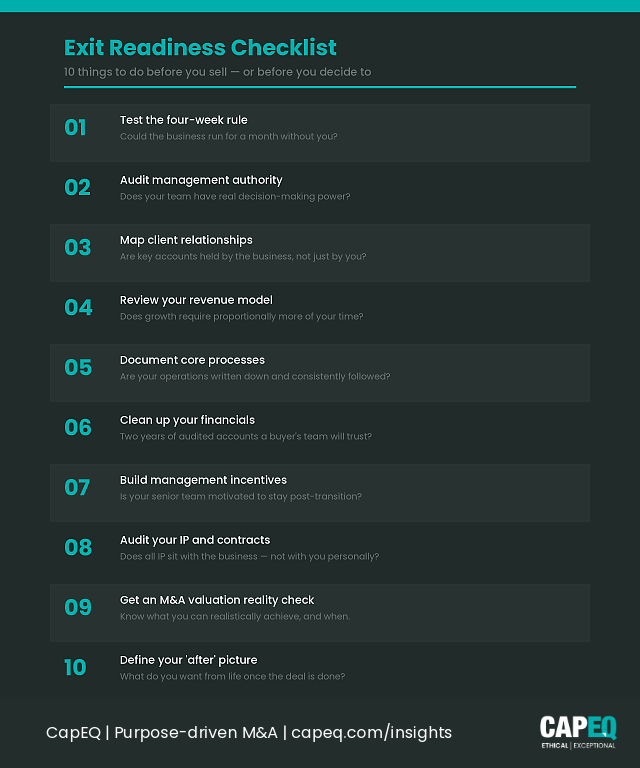
What does it mean to be trapped inside your business? Being trapped inside your business means the company cannot function effectively without your direct, daily involvement. The symptoms include constant interruptions, inability to delegate key decisions, client relationships that exist with you rather than the business, and the inability to take time off without commercial consequences. It is an operational design problem, not a personal one — and it has a direct negative effect on what your business is worth to a buyer.
How much does owner dependency reduce my business sale price? The impact depends on severity. Analysis published in early 2026 found that owner-dependent UK businesses typically achieve valuations 20–40% below comparable companies where the founder is not operationally central. In the most severe cases — where the founder is the primary salesperson, relationship holder, and decision-maker — the discount can reach 30–50% of enterprise value. Reducing dependency before going to market is one of the most reliable ways to increase what a buyer will pay.
How long does it take to reduce owner dependency before selling? There is no universal timeline, but as a rule of thumb, meaningful structural change takes 12–24 months to embed and be visible to buyers in your management accounts and team performance. Cosmetic changes made in the weeks before a sale process will not survive due diligence. The earlier you start, the better your negotiating position.
Should I sell my business or try to fix the dependency problem first? That depends on your circumstances and your appetite for the work involved. If you have the energy and the right team around you, reducing dependency before a sale will typically produce a better outcome. If you are genuinely burnt out, the business still has real value, and a good sale process is achievable, selling now — with honest preparation — may be the more practical choice. An experienced M&A adviser can help you assess which path makes sense for your situation.
What is the key-man discount and does it apply to me? The key-man discount (sometimes called the founder dependency discount or owner dependency discount) is the formal reduction a buyer or valuation professional applies to a business's enterprise value when its performance, relationships, or operational capability is concentrated in one person. It reflects the buyer's perception of transition risk — specifically, the risk that the business deteriorates after the founder leaves. If your business cannot clearly demonstrate it can operate without you, some version of this discount will apply. The good news is it is addressable with time and the right preparation.
What does a good exit look like for a founder who has felt trapped? A good exit gives you financial security on your own terms, a clean transition that protects your team and clients, and the ability to move into whatever comes next — whether that is a new venture, a portfolio of interests, or a period of deliberate rest. It does not require you to have a perfect business. It requires you to have a prepared one, with the right advisory support to run a process that surfaces real buyer competition and negotiates an outcome that reflects what you have built.
 Mark Sapsford is a Co-founder and Partner at CapEQ, the Certified B Corporation mid-market M&A advisory. Before CapEQ, he served in the Royal Air Force before building a career in energy and recruitment — including as part of the management team that sold a tanker driver recruitment business, giving him direct personal experience of what a founder exit involves. He has personally completed 51+ transactions and overseen more than 115 across sectors including energy, recruitment, and the wider UK mid-market.
Read his full profile on the CapEQ team page or book a confidential conversation.