Discover the CapEQ approach to a premium exit
Whether you're exploring your options or fending off offers, we're here to help.

Owner-dependent businesses are hard to sell and harder to enjoy — reducing dependency protects deal options and your life outside work.
Series: Getting exit-ready · Last updated: June 2026
The Gist
- Owner dependency — the degree to which a business cannot operate, win work or make decisions without its founder — is one of the most consistent reasons buyers reduce offers or walk away entirely.
- Severely founder-dependent businesses are often simply unsaleable. Where a deal does happen, buyers protect themselves by deferring a large share of the consideration into earn-outs, retention payments and extended handover commitments.
- Reducing dependency is not only about getting a better deal. It is the work that lets a founder take a real holiday, avoid burnout, and have a life outside the office — whether they sell next year, in ten years, or never.
- The credible reduction work happens 18–24 months before a sale. It cannot be retrofitted in the months before going to market — buyers can tell the difference between transferred responsibility and recently described transfer.
- In our experience across 115+ completed transactions, the founders who command the strongest terms are those whose absence is a question of timing, not survival.
- The work is mostly unglamorous: documenting decisions, transferring relationships, building a second tier of leadership, and learning — emotionally as much as operationally — to let go.
Owner-directors often play a dual role: the business's greatest asset and its single largest concentration of risk. The decision to sell brings both into sharp focus — but the cost of dependency is being paid long before any sale is on the horizon.
If you have ever caught yourself thinking "no one else knows it, lives it or loves it like I do" — you are not alone, and your passion is part of what built the business. The problem is what that dependency costs you. It costs you holidays you cannot fully take. It costs you the option to step back when you feel tired. And the moment a buyer looks at the company through a diligence lens, it costs you offers, terms, and sometimes the deal itself.
This article sets out what owner dependency actually looks like to a buyer, why it quietly damages founders long before any exit is in sight, and the ten practical things we ask CapEQ clients to do — usually over two years — to make themselves dispensable in the best possible way.
Owner dependency is the formal term valuers and acquirers use to describe a business whose operations, customer relationships, decision-making, or specialist knowledge rest disproportionately with one individual. It is sometimes called key-person risk — the central risk that one person's departure would materially damage trading.
Buyers test for it in three places.
Operational risk. Do day-to-day decisions stall or quality drop when the founder is absent? A useful diagnostic is whether the business has continued to function fully during a recent two- or three-week holiday — and whether anyone other than the founder can answer that question honestly.
Revenue risk. Are customers loyal to the company or to the person? In professional services and engineering consultancies in particular, contracts often follow individuals out of the door. A buyer will examine top-customer renewals through this lens.
Execution risk. Is the operating plan written down, or does it live in the founder's head? Informal knowledge, undocumented processes, and verbal handshake arrangements with suppliers all read as risk in a data room.
A significant number of CapEQ clients underestimate how thoroughly buyers stress-test for these things. By the time a credible acquirer has run a fortnight of diligence sessions, they will have a clear view on which of the three categories applies — and the terms of any offer will reflect it directly.
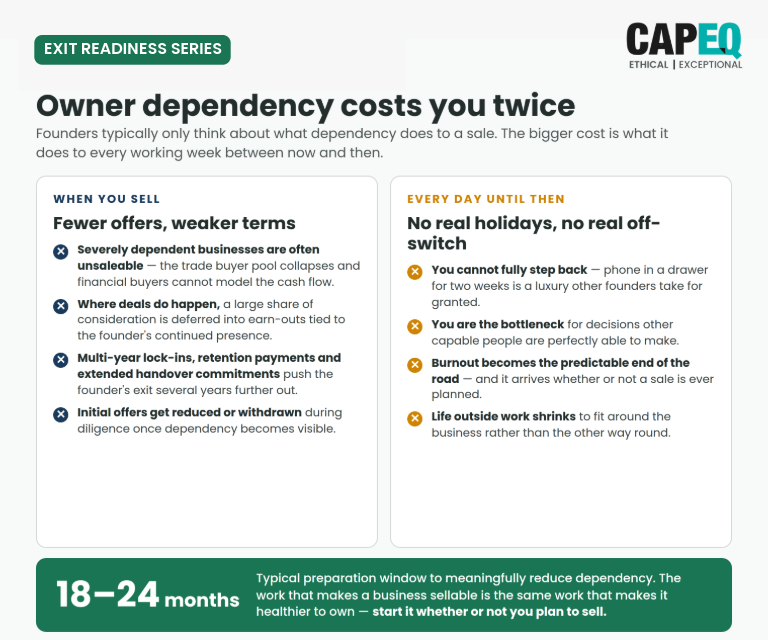
There are two reasons to take dependency seriously, and most founders only think about the second.
The first is the one that affects you every day. A business that depends on you is exhausting to run. You cannot take a real holiday — the kind where your phone genuinely stays in a drawer. You cannot step away when you are tired or unwell without things slipping. The decisions you make become increasingly defensive: you are protecting an operation that only works when you are at the centre of it. Founder burnout is the predictable end of this road, and it arrives whether or not a sale is ever planned.
Reducing dependency is therefore something you should be doing even if you have no intention of selling. The work that makes a business sellable is, almost without exception, the same work that makes it enjoyable to own. A genuinely transferable business is one where the founder gets to choose how much time they spend in it — including none at all, for weeks at a time, without anything going wrong.
The second is what happens when a sale does come into view. Severely owner-dependent businesses are often simply unsaleable. The buyer pool collapses to almost nothing because trade acquirers fear integration risk and financial buyers cannot model future cash flows with confidence. Where a deal does happen, buyers protect themselves by structuring it heavily around the founder's continued presence: a much larger share of the consideration deferred into earn-outs tied to post-completion performance, retention payments held back over multi-year periods, and extended handover commitments that lock the founder in well beyond the moment they had wanted to leave.
The headline price on those deals can sometimes look acceptable on paper. The cash you actually receive at completion does not. And the freedom you were trying to buy with the sale — the holiday, the next chapter, the time with family — gets pushed several years further out.
The two arguments compound. Founders who reduce dependency early get the day-to-day benefit immediately and the transaction benefit later. Founders who delay get neither.
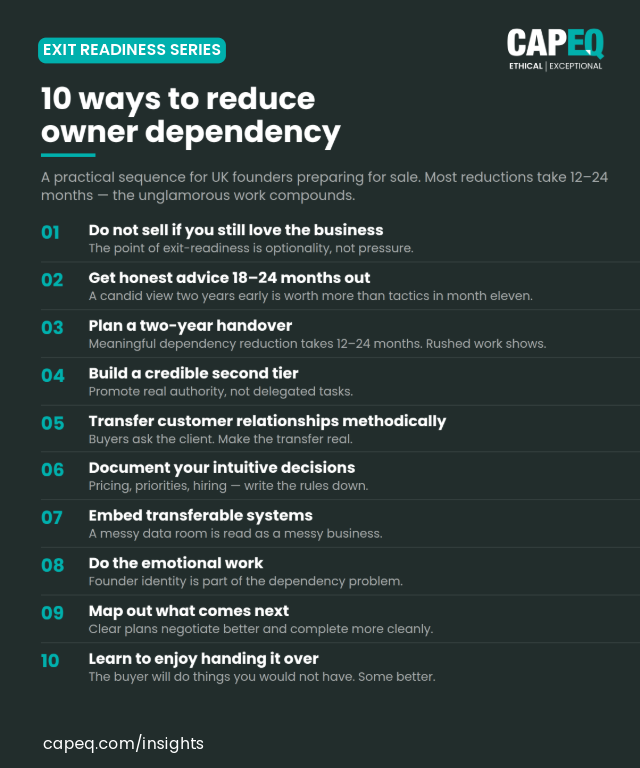
The easiest decision is not to sell. If you are still energised by the work, keep doing it. The point of exit-readiness is to give you the option to leave well — not to push you toward a door you do not want to walk through. The dependency work has the useful side effect of making the business genuinely more enjoyable to run in the meantime: you get your weekends back, you can travel without your inbox following you, and you stop being the bottleneck for decisions that other people are perfectly capable of making.
Think of it as being permanently exit-ready. You may never use the option. But having it changes how you feel about the business every day.
When you start to think about a sale, talk to an adviser who will tell you what your business actually looks like to a buyer today — not what you would like to hear. An empathetic but candid view, two years out, is worth more than any tactical advice given in the month before going to market.
Pro tip from Mark Sapsford: "The single best predictor of a clean exit is whether the founder started the dependency work before they thought they needed to. The clients who come to us 18 to 24 months out almost always achieve better outcomes than those who come to us six months out — even when the underlying business is similar. And the ones who started the work years earlier, for reasons that had nothing to do with selling, are in the strongest position of all."
Meaningful reduction in owner dependency typically takes 12 to 24 months — sometimes longer in businesses with deep founder-led customer relationships. This is the consistent picture across UK SME M&A commentary, and it matches our own client experience. Two years gives you time to recruit, train, transfer relationships, embed processes, and prove out the new structure before a buyer sees it.
If you genuinely believe that the sky falls in when you are absent, you probably have the wrong people in place — or the right people without enough authority. Either way, the answer is the same. Recruit deliberately for the gaps you currently fill. Promote internal talent where they are ready. Give your senior team real decisions to own, not delegated tasks to administer.
The litmus test is whether your management team can describe the company's strategy in your absence, in their own words, without checking back with you.
If one client accounts for 20% of revenue and you personally own that relationship, the work is to introduce a second relationship-holder and give them time to earn trust. This rarely happens organically. It happens because someone made a plan, sequenced introductions, attended fewer meetings, and let the other person lead.
Buyers can tell the difference between a relationship that has been transferred and one that has been described as transferred. They will ask the client.
Founders make hundreds of small judgement calls a week — pricing, prioritisation, hiring, supplier choice — that feel intuitive but rest on years of pattern recognition. Buyers want to see those judgements written down as principles, frameworks or simple decision rules. Not a 200-page operations manual. A clear set of "this is how we decide" documents that someone else could apply.
Operations, financial reporting, CRM, lead handling, onboarding — every recurring process should be visible, accessible and consistent enough that a new owner could step in without rebuilding it. This is where most buyers form their first impression of a business in diligence. A messy data room is read as a messy business.
A lot of owner dependency reflects feelings, not facts. Founders whose identity, status and daily structure are tied to the business find it genuinely hard to let go — even when the rational case is clear. Naming this honestly is part of preparing for a clean exit, and part of building a healthier relationship with work in the meantime. Some of our clients find they need to spend as much time getting their head and heart aligned as they do preparing the company itself.
Founders who have a clear picture of life after the sale tend to negotiate better, complete more cleanly, and regret less. Those who have no plan often hesitate at the final stage, or accept structures (long earn-outs, ongoing consultancy roles) that lock them back into the business they were trying to leave.
Even if you never sell, the act of mapping out what you would do with more time tends to surface the question of why you do not already have it.
When a sale does happen, the buyer brings capital, capability and ideas you do not have. They will do things you would not have done — some of which will work better than your way. Watching the business move into its next phase under new ownership is part of the reward. Founders who frame the sale as a beginning rather than an ending tend to enjoy the process, and the outcome, considerably more.
| Dependency level | What buyers see | Typical impact on terms |
|---|---|---|
| Severe — founder is essential to revenue, decisions, and operations | A role, not a transferable asset | Often unsaleable; where a deal completes, the majority of consideration is deferred |
| High — concentrated customer relationships, undocumented processes | Significant integration risk | Substantial earn-out and retention structure; extended founder lock-in |
| Moderate — strong founder presence but capable second tier | Manageable transition | Standard handover (12–24 months); modest deferred element |
| Low — founder's absence is a timing question, not a survival one | A transferable cash flow | Competitive process; clean structure achievable, weighted to cash at completion |
A practical summary you can apply this quarter — whether or not a sale is on the horizon.
 Frequently asked questions
Owner dependency is the degree to which a business's operations, revenue, decisions or knowledge rest on a single individual — usually the founder or owner-director. In M&A diligence, buyers assess dependency across three dimensions: operational (does the business run without the founder?), revenue (are customers loyal to the company or the person?), and execution (is the operating model documented or held in one person's head?). High dependency reduces the buyer pool, weakens the terms on offer, and increases the proportion of consideration deferred into earn-outs.
Severely owner-dependent businesses are often unsaleable. The trade buyer pool shrinks because acquirers fear integration risk, and financial buyers cannot reliably model future cash flows. Where a deal does complete, buyers protect themselves by structuring it heavily around the founder's continued presence: a much larger share of consideration deferred into earn-outs, retention payments held back over multi-year periods, and extended handover commitments. The headline number on those deals can look acceptable; the cash actually received at completion, and the founder's freedom to walk away, do not.
Meaningful reduction typically takes 12 to 24 months, and longer in businesses with deeply embedded founder-led customer relationships. The work cannot be credibly compressed into the final months before going to market — buyers can tell the difference between transferred relationships and recently described ones. CapEQ generally advises founders to start the dependency work 18 to 24 months before any intended exit, alongside broader exit-readiness preparation.
Yes. The work that makes a business sellable is almost the same work that makes it healthy to own. A business that does not need its founder constantly present is one where the founder can take real holidays, step back when needed, avoid burnout, and have a life outside work. CapEQ encourages clients to think of dependency reduction as permanent exit-readiness — preparation that pays a daily dividend in quality of life, whether or not the option to sell is ever exercised.
Sometimes, but the terms will reflect the dependency, and severely dependent businesses may not find a buyer at all. Where a deal is achievable, buyers typically structure a larger share of the consideration as deferred or earn-out payments, require an extended handover commitment from the founder, and apply less favourable terms throughout to compensate for transition risk. Founders who proceed without first reducing dependency often complete with significantly worse terms than they expected, or find that initial offers are withdrawn or reduced during diligence.
A key-person discount is the reduction in value buyers and valuers apply when one individual is central to the business — typically the founder, but sometimes a key salesperson or technical specialist. It reflects the buyer's assessment that the individual's departure would materially damage trading. Depending on the severity, it ranges from a modest adjustment to terms through to the business being considered effectively unsaleable. In owner-managed UK SMEs, key-person risk is one of the most common findings in pre-deal diligence.
Yes — in two ways founders often underestimate. Day to day, it gives back the time and freedom that come from not being the centre of every decision. At sale, it widens the buyer pool, sustains a more competitive process, and shifts the consideration toward cash at completion rather than deferred earn-outs. The headline multiple may improve. The more reliable benefit is in deal certainty, structure, and the founder's freedom to refuse a thin offer rather than accept it from necessity.
 Mark Sapsford is a Co-founder and Partner at CapEQ. He served in the RAF before building a career in energy and recruitment, and was part of the management team that personally sold a tanker driver recruitment business — giving him first-hand experience of the founder's side of a transaction. Mark has personally led 51+ completed deals and overseen 115+ across CapEQ's transaction history, with a particular focus on energy, recruitment and the general UK mid-market. Meet the CapEQ team or book a confidential conversation.