Discover the CapEQ approach to a premium exit
Whether you're exploring your options or fending off offers, we're here to help.

An unsolicited offer to buy your business is a high-stakes moment under real pressure — here's how UK founders respond well.
Series: Business sale process · Last updated: June 2026
The Gist
- Unsolicited approaches have become near-inevitable in active UK sectors, with SME deals under £100m representing 88% of all disclosed-value M&A transactions in 2025.
- Most cold approaches are screening exercises, not firm offers — the first call is designed to gauge appetite and extract information, not to transact.
- Bolt-on acquisitions accounted for 59% of UK private equity deals in 2025, meaning many approaches come from sponsor-backed buyers running active buy-and-build mandates.
- The single highest-value move is to slow the process down: a polite delay of four to eight weeks costs the buyer nothing if they are serious, and protects the seller from being railroaded into exclusivity.
- Signing an exclusivity (or "lock-out") agreement before you have tested the market typically removes competitive tension and reduces final consideration by 10–30%.
- Treat the approach as a signal worth investigating, not a deal worth closing — the founders who realise the best outcomes are the ones who use the moment to get exit-ready, then run a process.
If you run a profitable UK business above roughly £1m EBITDA, you will be approached. The only question is when, and by whom.
Private equity dry powder, trade consolidation in fragmented sectors, and the rise of search funds have all expanded the pool of active buyers. UK SME M&A under £100m generated £20.3bn of aggregate disclosed value in 2025 alone, and PE bolt-on activity continues to dominate — making up nearly six in ten reported deals last year. Sponsor-backed platforms run continuous origination programmes. Their analysts are paid to find you.
So the approach itself tells you very little. What matters is what you do in the 48 hours that follow.
Most founders react with a mix of flattery, suspicion, and a quiet calculation about what the business might really be worth. None of those reactions is wrong. But each one is a poor basis for the next decision.
An unsolicited approach is an expression of interest in acquiring your business from a buyer or adviser you have not invited into a process. It typically arrives as a cold email, a LinkedIn message, or a phone call from a corporate finance boutique acting on behalf of a named or unnamed client.
It is rarely an offer in any meaningful sense. The sender usually has no agreed price, no funding committed, and no confirmed mandate to transact at the level you might assume. They have a brief, a shortlist, and a target sector.
A useful frame: an unsolicited approach is a screening conversation dressed up as an opportunity. The screening flows one way — towards them. They want to learn about your revenue mix, customer concentration, EBITDA, and how reachable a deal might be. You learn very little in return.
That asymmetry is fixable. But only if you take control of the pace.
Not all approaches are equal. Before responding, work out which of these you are dealing with.
A direct competitor, an adjacent operator, or a larger group looking to consolidate. These approaches tend to be the most considered: the buyer already understands your market and has a thesis on what you add. They are also the most sensitive on confidentiality — if a competitor learns your financials and walks away, the cost can be significant.
Private equity portfolio companies running buy-and-build strategies. Their adviser will often soften the language ("just an introductory conversation") but the underlying mandate is acquisitive and time-pressured. Sponsors typically want to deploy within a defined hold period, which can be a useful lever for sellers who do choose to engage.
The most common — and the most variable in quality. Some are credible advisers running genuine mandates. Others are running broad sweeps to build a saleable database of motivated sellers. If the approach is vague about the buyer's identity, sector logic, or rationale, treat it as fishing until proven otherwise.
Each of these is recoverable if caught early. None of them is recoverable once an exclusivity agreement is signed.
Engaging emotionally. A flattering email is not market evidence of your valuation. Buyers know this.
Sharing too much, too soon. Top-line revenue and broad sector positioning are fine. Detailed P&L, customer-level data, contract terms, and key-person information are not — at least not until there is a signed NDA and a credible process running.
Anchoring on the first number. If a buyer floats an indicative range, that number will become the gravitational centre of every subsequent conversation. Premium outcomes rarely come from negotiating up from a buyer-set anchor. They come from competitive tension.
Underestimating the time cost. Even an exploratory conversation can absorb fifteen to thirty hours of management attention across a quarter. If the deal stalls, that time is gone — and so is the focus that should have been on the business.
Signing exclusivity before testing the market. A lock-out agreement removes your ability to talk to other buyers, typically for sixty to ninety days. Buyers ask for it because it works for them. In our experience, sellers who enter exclusivity off the back of an unsolicited approach realise final consideration meaningfully below what a competitive process would have produced — often in the 10–30% range.
Pro tip — James Pugh, Co-founder and Partner at CapEQ: "I've sat on both sides of this. When I sold one of my previous businesses, the temptation to engage with the first credible-looking approach was real — because it felt like they would validate what we'd built. The discipline that matters most is the one nobody talks about: not responding for a few days.
The buyers who matter will still be there. The ones who won't were never serious."
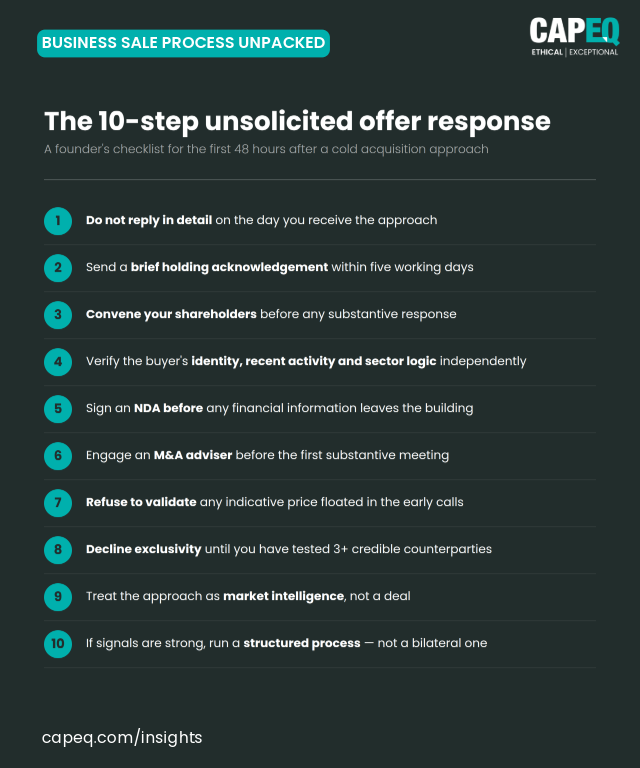
There is a clean playbook for the first two days, and it does not involve replying immediately.
A short, polite reply — "Thank you for getting in touch. I'll come back to you in the next couple of weeks" — is enough. You owe the sender nothing more at this stage. Resist the urge to add context, share a deck, or open a calendar slot.
Even small founder-led businesses often have multiple shareholders with different exit aspirations. Approaches reveal these fault lines fast. One shareholder may want liquidity tomorrow; another may want to roll equity into a larger group; a third may want no part of it. Surfacing these views before you engage with the buyer prevents the deal from blowing up later on internal disagreement.
Verify the buyer's identity, recent transactions, fund stage (if PE), and reputation among sellers in your sector. A twenty-minute call with a corporate finance adviser who knows the buyer is worth more than a week of reading their website.
Engage an M&A adviser — even briefly — before the first substantive meeting with the buyer. This is the most asymmetric investment a seller can make. The cost is modest. The downside of skipping it can be a deal struck at the wrong price, on the wrong structure, with the wrong people.
There are three legitimate responses, and only three:
What is not appropriate is the fourth response many founders default to: meandering, exclusive, exploratory dialogue with the first buyer who comes knocking.
| Signal | What it suggests | Recommended posture |
|---|---|---|
| Named buyer with clear sector logic | Likely strategic or sponsor-backed mandate | Acknowledge, delay, verify, advise |
| Anonymous buyer, vague rationale | Likely origination sweep or fishing | Polite decline, no follow-up |
| Specific indicative range provided unprompted | Buyer is anchoring early | Refuse to validate the range; do not counter |
| Pressure for an early meeting or NDA | Buyer is trying to lock you in | Hold the timeline; let them wait |
| Multiple credible approaches in 90 days | The market is signalling readiness | Get exit-ready and consider running a process |
| Approach in a sector with active consolidation | Bolt-on mandate likely | Treat as market intelligence, not a deal |
Most cold approaches deserve a polite delay and very little more. But some warrant real attention. The signals to look for:
If those four signals are present, the approach is worth taking seriously — through a properly advised process, not a one-to-one dialogue.
What does "unsolicited offer" actually mean in UK M&A?
An unsolicited offer is an expression of interest in acquiring your business from a buyer you have not invited into a sale process. It is almost always indicative rather than firm — meaning there is no committed price, funding, or binding intent — and is typically the opening move in a longer dialogue designed to test seller appetite. In the UK SME market, these approaches now arrive routinely in active sectors and should be treated as the beginning of a conversation, not the end of one.
Should I tell the unsolicited buyer my asking price?
No. Naming a number first in response to a cold approach almost always works against the seller. If your figure is too low, the buyer will anchor to it for the rest of the negotiation. If it is too high, the buyer may walk away rather than reset expectations. The correct response is to decline to name a price and indicate that any valuation discussion will take place through a structured process with proper financial information on the table.
How long should I wait before responding to an unsolicited offer?
Acknowledge briefly within five working days so the sender knows the message landed. Take four to eight weeks before any substantive response or meeting. This window costs a credible buyer nothing — they will wait — and gives you time to align shareholders, verify the buyer, engage an adviser, and decide your stance. Buyers who refuse to wait are usually trying to short-circuit competitive tension, which is itself useful information.
Can I be forced to sell my business if I receive a serious offer?
No. In private UK M&A there is no equivalent of the public-company takeover regime, and no buyer can compel a private seller to engage. Approaches are entirely voluntary on both sides. You can decline to respond, decline to meet, decline to disclose information, and decline to negotiate, at any point and for any reason, without legal consequence.
What should I never share with an unsolicited buyer before signing an NDA?
Detailed financials beyond top-line revenue and broad EBITDA range; customer-level data, including names of major accounts; supplier terms and key contract economics; employee data and key-person dependencies; pipeline and forecast assumptions; and any indication of your minimum acceptable price. Anything that would damage you if it reached a competitor should not leave the building until both an NDA and a credible process are in place.
Is it ever a mistake to ignore an unsolicited offer?
Occasionally, yes — but rarely the mistake founders fear. The risk is not missing the one buyer who would have paid extraordinary value. The risk is missing the signal that your business is now visible to active buyers, and failing to use that signal to get exit-ready while you still have time. Treating the first approach as market intelligence — even if you decline to engage with it — is usually the right move.
 James Pugh is Co-founder and Partner at CapEQ. He leads M&A advisory mandates across B2B SaaS, healthcare, FMCG and more, and has personally led 50+ transactions including Liberty Flights (sold to Supreme Plc), Vegetarian Express (Bridges Ventures), and AV Danzer (Wernick Group).
His work focuses on founders preparing for a first exit who want competitive process discipline without losing control of the outcome.
Meet the CapEQ team · Book a Discovery Conversation with James