Discover the CapEQ approach to a premium exit
Whether you're exploring your options or fending off offers, we're here to help.

Some businesses are simply harder to replace than others — and buyers pay accordingly. Here is what creates that scarcity premium.Series: M&A Valuation Drivers · Part 2 of an ongoing series · Last updated: 2 May 2026
The Gist
- The scarcity premium is the extra value buyers pay when a business owns something rare and hard to replicate.
- Five drivers create scarcity: proprietary technology, niche market position, exclusive contracts, specialist talent, and loyal customers.
- Scarce assets often spark competitive bidding, which can lift the final price well above standard valuation multiples.
- Sellers should identify and protect scarce assets early. Buyers should test whether the scarcity is real and durable.
- At CapEQ, we see this play out across mid-market M&A transactions — from artificial intelligence (AI) start-ups to niche industrial brands.
The scarcity premium is the additional value a buyer pays for a business that owns something rare or hard to replicate. In mergers and acquisitions (M&A), it is one of the most powerful drivers of a sale price — and it routinely pushes valuations beyond what standard financial multiples predict.
Put simply: when something is scarce and someone wants it, the price goes up. The same supply-and-demand logic that governs property, art, and football transfers also governs M&A. We see it in nearly every competitive process we run.
A buyer pays a multiple of earnings to acquire a business. But when that business owns something a buyer cannot easily build, buy elsewhere, or wait out, the multiple climbs.
Five things make a business scarce in the eyes of acquirers:
When any of these are present, buyers compete harder. And when buyers compete, sellers benefit.
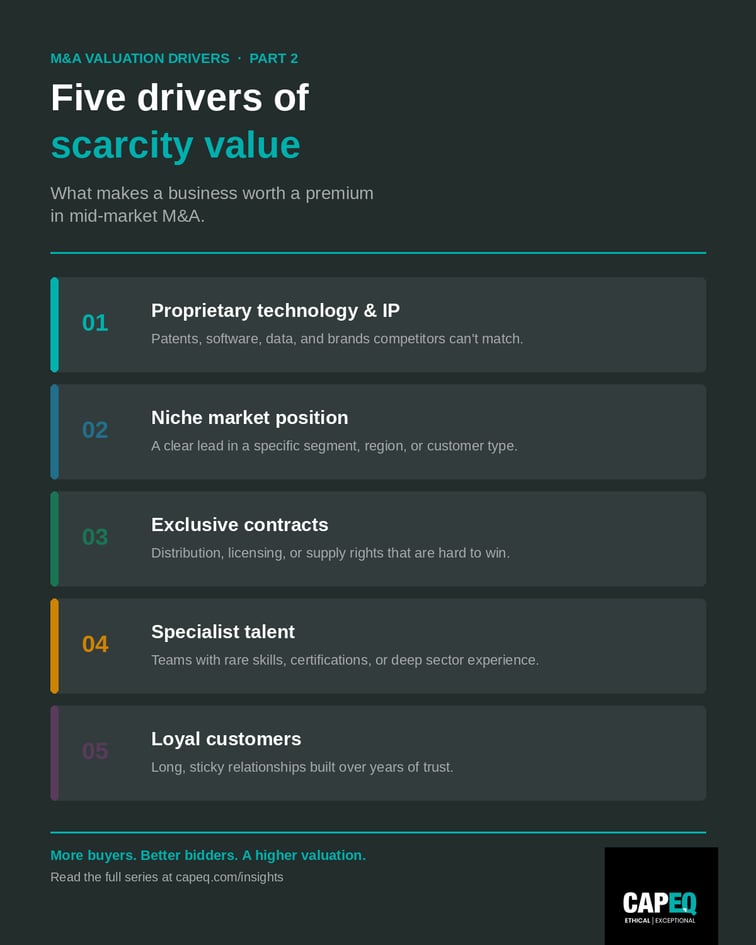
A scarce business attracts more interested buyers. More interested buyers means a competitive process — sometimes a full auction — and that pressure rewards the seller with a higher final number.
We saw this clearly when we sold London-based AI firm Factmata to Cision in 2022. Factmata had built award-winning narrative-monitoring technology — the kind of proprietary AI that competitors could not quickly replicate. Even as the start-up faced scaling challenges, several acquirers approached the founders. Within nine months of engaging us, the business was sold into Cision's AI division and all seven of Factmata's developers were redeployed into senior roles. The technology was scarce. The talent was scarce. Both translated directly into deal value.
Sometimes a buyer is not just choosing between options — they need a specific business to deliver their growth plan. That changes the negotiation entirely.
When Netcall PLC acquired Govtech Solutions, the buyer was not buying any automation platform — they were buying access to a specific government-software niche where Govtech Solutions had earned trust and integration depth. That sector position made Govtech the right deal, not just a good one.
A control premium is the extra amount a buyer pays to take full ownership rather than a minority stake. When the target holds scarce assets — a patent, a regulatory licence, a unique data set — the control premium reflects the buyer's wish to own and direct that advantage outright.
We saw this when we advised on the sale of Autus Data Services to ISS Market Intelligence. The acquirer wanted full control of a unique financial-data platform, not partial access through a partnership. Scarcity made the asset worth owning outright.
If you are thinking about an exit, the scarcity premium is the lever most owners overlook. Most owners focus on the profit and loss (P&L). Buyers also look hard at what they cannot get anywhere else.
Five things will help you make the most of yours:
| Action | Why it matters |
|---|---|
| Identify what makes you scarce | Walk through your business honestly. What would a buyer struggle to build, copy, or buy elsewhere? Tech? People? Customers? Contracts? |
| Protect your intellectual property | File patents and trademarks where you can. Register domain names and copyrights. Work with a specialist IP lawyer to make sure your defences hold up. |
| Document your market position | Pull together the data that proves you lead your niche — market share, customer wins, awards, press, partner status. |
| Lock in key contracts and people | Long, signed customer contracts and well-incentivised teams turn vague advantages into real, transferable value for a buyer. |
| Tell the story clearly | Buyers pay for what they understand. A focused narrative that highlights your scarce assets is worth more than a long list of features. |
Pro tip from our partners
Take time to really understand the value of the IP in your business — including licences, domain names, copyrights, and databases. It will help you make better decisions about where to invest, what research and development (R&D) work to prioritise, and which technologies or brands to build up before you go to market.
If you are an acquirer, the scarcity premium can be the right thing to pay — or a trap. The difference is in the diligence.
Three questions to ask before you stretch on price:
Read more on the related topic of how synergies affect M&A valuations — together, scarcity and synergies are the two most powerful drivers of premium pricing in mid-market deals.
Our job is to find your scarce assets, prove their value to the right buyers, and use them to drive a competitive process. Across hundreds of completed transactions — from AI companies to industrial businesses, from healthcare to renewable energy — the pattern is consistent. Scarcity is the lever that secures the maximum defensible valuation.
We help you:
If you are thinking about a sale in the next 12–36 months, the work to surface and protect your scarce assets starts now. We are happy to help you scope it.
What is the scarcity premium in M&A? The scarcity premium is the additional amount a buyer pays for a target business that owns rare or hard-to-replicate assets — such as proprietary technology, exclusive contracts, niche market dominance, specialist talent, or a loyal customer base.
How much does scarcity add to a business valuation? There is no single number. The lift depends on the buyer, the asset, and how well the sale process surfaces both. In competitive processes for genuinely scarce mid-market businesses, we have seen valuations land well above standard earnings before interest, taxes, depreciation, and amortisation (EBITDA) multiples for the sector.
What is a control premium? A control premium is the extra amount a buyer pays to acquire a controlling stake — usually more than 50% — rather than a minority interest. Control lets the buyer set strategy and direct cash flows, which is especially valuable when the target holds scarce strategic assets.
Can a small business benefit from a scarcity premium? Yes. We work with mid-market businesses (typically £5M–£100M in revenue) where scarcity routinely shifts valuations. A small company with the right IP, customers, or market position can attract premium pricing — sometimes more than a much larger but less differentiated competitor.
How do I find out what's scarce about my business? Start with three questions: What would a buyer struggle to build? What would they struggle to buy elsewhere? What would they pay to stop a competitor from owning? An experienced M&A advisor can help you stress-test the answers and translate them into a credible, defensible story for buyers.

Douglas Edmunds is a Partner at CapEQ, the Certified B Corporation mid-market M&A advisory. He has led transactions across technology, healthcare, industrials, and financial services sectors over a 15-year M&A career. Read his full bio or book a confidential chat.
.This article is part of our M&A Valuation Drivers series. See also: