Discover the CapEQ approach to a premium exit
Whether you're exploring your options or fending off offers, we're here to help.
Published: August 2026 | Reporting period: August 2025 – August 2026 | Deal focus: sub-£100m | Reading time: 9 minutes
Deal activity across UK and European Testing, Inspection, Certification and Compliance (TICC) held steady through the reporting period, even as the wider M&A market cooled. The sector's recurring, compliance-driven revenues make it defensive, and both private equity and trade buyers have kept processes moving where other sectors stalled.
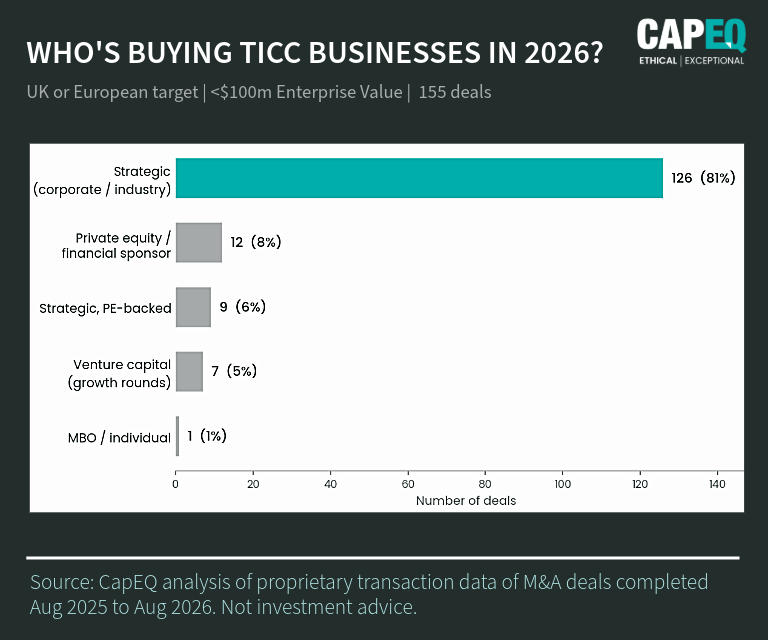
The market is best read through deal count, acquirer mix, and average deal size — not headline value. CapEQ tracked 155 sub-£100m TICC transactions across the UK and Europe in the 12 months to August 2026, and the composition tells the story. Around 126 were strategic corporate acquirers, most of them established TIC consolidators — Phenna, Normec, Kiwa, Certania, SOCOTEC, Bureau Veritas, TÜV SÜD, and Eurofins among them — building out platforms deal by deal.
A further 21 involved a financial sponsor: 12 direct private-equity acquisitions and nine where a sponsor stood behind a strategic buyer. Seven were venture growth rounds into compliance and quality-assurance technology, and one was a founder buyback.
The weight of activity is sub-£100m bolt-on consolidation, so the average deal size sits well within the mid-market band, while a small number of large platform and take-private processes pull aggregate value upwards and make it a poor gauge of the typical transaction.
For founders, the takeaway is direct: appetite is strong but conditional. Buyers are underwriting recurring-revenue quality, accreditation depth, operational independence, and compliance readiness with a rigour that did not exist eighteen months ago. Diligence now reaches well beyond the financials into ESG standing, key-person exposure, contract durability, and the ability of the business to stand alone after completion.
Mid-market TICC multiples cluster in a 6×–10× EBITDA range, but that range is doing less work than it used to. Well-prepared, accredited, recurring-revenue platforms clear at the top of it, while founder-dependent, single-market, or under-digitalised businesses clear well below, or do not clear at all. Founders considering an exit in the next one to three years should treat readiness, not market timing, as the primary lever within their control.
Four forces are compounding at once.
The result is resilient dealmaking across the region — steady deal counts alongside a rising average deal size — concentrated on businesses with proven recurring revenue, credible accreditations, and a digitalisation strategy already embedded rather than aspired to.
Global backdrop
Globally, TIC M&A stayed resilient against a softening backdrop, and the story is again one of count rather than value. Deloitte recorded 181 TIC deals in 2025, up from 127 in 2024, even as overall global M&A activity slipped around 7% year-on-year in the opening months of 2026.
As in the UK and Europe, most of that count is bolt-on scale in the sub-£100m band, keeping the average deal size modest despite a few headline-grabbing large-cap processes. The most active acquirers remain the large multinationals — Bureau Veritas, Intertek, and SGS among them — alongside private equity pursuing platform and bolt-on deals to extend geography and capability.
Premium global multiples track in a broadly similar 6×–10× EBITDA band, with the same divergence between accredited, recurring-revenue platforms and founder-dependent operators.
Regulators worldwide, from the UK CMA to competition authorities across Europe and beyond, are scrutinising both competitive practices and labour-market arrangements in professional services, adding to diligence load.
Four patterns define the current market, consistently on both sides of the Channel.
| Trend | Description | What we are seeing |
|---|---|---|
| Platform buy-and-build | PE and trade buyers acquire smaller regional or specialist operators and layer them onto larger, scalable platforms | Active TIC consolidators — Phenna, Normec, Kiwa, Certania, SOCOTEC, GBA, and Eurofins among them — rolling up specialist regional operators, with sponsors including Renatus, Quadriga, Eurazeo, LDC, and H.I.G. backing strategic buy-and-build |
| Strategic consolidation | Larger incumbents buy to broaden service lines, geographies, or vertical expertise and to offer a "one-stop" compliance proposition | Multinationals such as Bureau Veritas and TÜV SÜD, alongside mid-market consolidators (CARSO, Sansidor, Celnor), acquiring niche capability in ESG certification, cyber and data-privacy assurance, HR and workplace-safety compliance, and supply-chain assurance |
| Cross-border dealmaking | International acquirers target UK and European operators with regional or sector leadership | Pan-European consolidators — Dutch (Normec, Kiwa), German (Certania, TÜV SÜD), French (CARSO, SOCOTEC), and Luxembourg-based (Eurofins) — pursuing UK and European operators; UK-listed TIC assets drawing inbound foreign interest |
| Structured, aligned deals | Consideration blends upfront value with performance-based and retention mechanisms | Earn-outs, management and founder rollover equity, deferred consideration, vendor due diligence, and carve-outs with transition service agreements now standard, particularly where founder involvement is critical post-deal |
Deal structuring has become markedly more flexible. Earn-outs and equity rollovers are now frequently a requirement rather than an option — in testing services specifically, the large majority of deals feature some form of management or founder rollover to align incentives and bridge valuation gaps. Corporate carve-outs bring transition service agreements and integration complexity, and in regulation-heavy niches, licensing partnerships and collaboration agreements sometimes serve as a precursor to full acquisition.
Growth capital is flowing to the digital edge of the sector in parallel with the consolidation. Seven of the 155 tracked deals were venture rounds into compliance and quality-assurance technology — among them Flinn, Scope AI, CertHub, Azumuta, Complear, Qooling, and Snellium — evidence that buyers and investors alike are pricing digital compliance capability as a durable advantage rather than a nice-to-have.
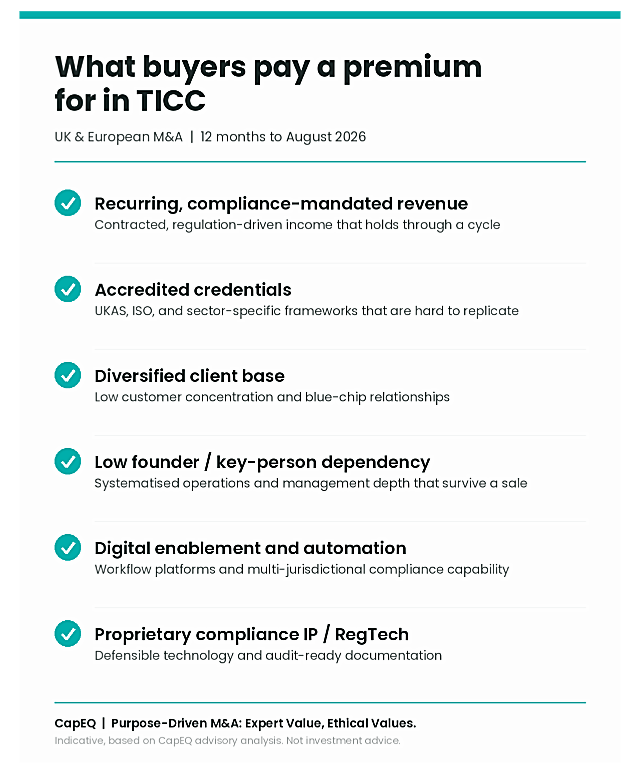
Buyers are paying a clear premium for defensible recurring revenue, accredited expertise, and independence from founder and key-person risk — a pattern consistent across testing, inspection, certification, and compliance, and across the UK and European markets. Multiples have compressed from the 2021–22 peaks but remain resilient for quality assets.
The pool of deals commanding a multiple at the top of the range is narrowing as buyers become more sophisticated about diligence and risk transfer. Risk-pricing is sharper: issues that suggest systemic operational, compliance, or reporting weakness increasingly lead to valuation discounts or retention-heavy deal structures rather than a walk-away, but the effect on headline value is real.
The exit decision is rarely driven by a single factor, and the pattern holds across UK and European founders alike. It is the accumulation of six pressures, several of them structural rather than cyclical.
For many founders, an exit is not defeat but adaptation to sector realities — a way to fund the next phase of the business, protect a team and a legacy, and step back on their own terms rather than under pressure.
Across the 12 months to August 2026, CapEQ tracked 155 sub-£100m TICC transactions in the UK and Europe. The acquirer mix is the clearest read on where the market's momentum sits.
| Acquirer type | Deals | Share | Representative buyers / investors |
|---|---|---|---|
| Strategic (corporate / industry) | 126 | ~81% | Phenna, Normec, Kiwa, Certania, CARSO, GBA, SOCOTEC, Bureau Veritas, TÜV SÜD, Sansidor, Celnor, Eurofins |
| Strategic, PE-backed | 9 | ~6% | WH Scott (Renatus), GBA (Quadriga), Certania (Greenpeak / Summit), Ekoscan (Eurazeo), IDSL (LDC), Protos (H.I.G.) |
| Private equity / financial sponsor | 12 | ~8% | Xenon, Fremman, Montyon, Framheim, NORD Holding, Queen's Park Equity, Rose Street |
| Venture capital (growth rounds) | 7 | ~5% | Flinn, Scope AI, CertHub, Azumuta, Complear, Qooling, Snellium |
| MBO / individual | 1 | ~1% | KFB Acoustics (founder buyback) |
| Total | 155 | 100% |
Shares are rounded and do not sum precisely to 100%. A financial sponsor was involved directly or behind a strategic buyer in 21 deals (~14%).
Source: CapEQ analysis of proprietary transaction data, 12 months to August 2026. Continental European transaction data is less consistently disclosed than UK data.
The forward pipeline is firm. Deal volumes are expected to stabilise or rise modestly — more mid-cap activity, fewer mega-deals — underpinned by compliance-driven demand and sector resilience.
This report synthesises publicly reported UK and European testing, inspection, certification, and compliance transaction data, sector commentary, and CapEQ advisory analysis for the 12 months to August 2026. It draws together four UK and European source strands — testing services, inspection services, certification and compliance services, and the combined TIC market, compiled over a broadly coincident 12-month window — under the single TICC umbrella. Global data is included only as a low-priority backdrop.
This report leads on deal count and average deal size rather than aggregate deal value. Aggregate value in TICC is distorted by a small number of large platform and take-private processes, so the typical sub-£100m transaction is characterised by count and size band; precise average deal sizes (value divided by count) will be computed from the curated transaction dataset once supplied.
Verified deal multiples for sub-£100m UK and European TICC transactions are not consistently disclosed. Indicative valuation ranges are derived from comparable, publicly reported transactions across the four strands, and are stated as ranges rather than points where disclosure is partial.
UK transaction data is more consistently disclosed than continental European data. Where European-specific evidence was limited, this report draws on cross-border and pan-European buy-and-build activity as the clearest available indicator of the wider market.
This report is anchored on CapEQ's proprietary dataset of 155 sub-£100m TICC transactions in the UK and Europe for the 12 months to August 2026, supported by the four UK and European source strands. Deal-level values are still being compiled; named acquirers and investors are drawn from that dataset. This report does not constitute investment advice.
CapEQ is a Certified B Corporation lower mid-market M&A advisory, working with founders and shareholders of businesses in the sub-£100m range on sell-side, buy-side, and growth mandates. Founded in 2020 and B Corp certified in 2021, the firm pairs institutional-grade advice with a values-led approach .
CapEQ's partners have advised on testing, inspection, and regulatory-compliance transactions across their careers. Relevant experience includes:
Resilient, compliance-driven recurring revenue, rising regulatory complexity, and the opportunity to consolidate a fragmented market. Both trade buyers and private equity are highly active, favouring businesses with strong accreditations, recurring contracts, and demonstrable digital or compliance capability. Cross-border buyers remain particularly interested in UK assets with European footprints, reinforced by a perceived valuation discount and currency effects.
Strategic corporate acquirers dominate. Of the 155 sub-£100m TICC deals CapEQ tracked in the 12 months to August 2026, around 126 were strategic buyers — largely established TIC consolidators such as Phenna, Normec, Kiwa, Certania, SOCOTEC, Bureau Veritas, TÜV SÜD, and Eurofins — pursuing platform-building and bolt-on strategies. A financial sponsor was involved in a further 21 deals, directly or behind a strategic buyer, and seven were venture growth rounds into compliance and quality-assurance technology. In certification and compliance specifically, PE participation reached roughly 19%, up from about 13% a year earlier. Cross-border buyers remain particularly interested in UK assets with European footprints.
Mid-market TICC assets typically trade in a 6×–10× EBITDA range, with variation by sub-segment — inspection tends towards 6×–9×, and testing and certification towards 7×–10×. The upper end is reserved for recurring-revenue, accredited platforms with diversified clients and low founder dependency. Founder-dependent, single-market, or under-digitalised businesses clear well below.
Consideration increasingly blends upfront value with earn-outs tied to post-completion performance, management or founder rollover equity, and deferred consideration — often alongside vendor due diligence and, in carve-outs, transition service agreements. These tools bridge valuation gaps, keep key talent engaged, and secure regulatory continuity post-acquisition.
Succession gaps and thin internal succession, the capital intensity of accreditation, technology, and compliance investment, an expanding regulatory load, margin pressure, competition from better-capitalised global platforms, and a desire to de-risk personally. For many owner-managers, a sale is a route to fund the next phase, protect a team and legacy, and secure liquidity while buyer demand remains favourable.
Prepare early. The highest-impact move is to systematise the business — reducing client and operational dependence on the founder, evidencing recurring revenue, and codifying compliance and accreditation standards — so it is attractive to the widest range of buyers at the highest multiple. Deal outcomes in this segment are separated more by preparation than by market timing, and specialist M&A advice helps you anticipate buyer questions and defend value in diligence.