Discover the CapEQ approach to a premium exit
Whether you're exploring your options or fending off offers, we're here to help.
Global govtech deal volume hit $20.5 billion — a new record, surpassing the previous high of $13.1 billion set in 2021 — driven by strategic buyers, private equity consolidators, and the disruptive arrival of AI-native platforms in public sector workflows.
For founders and major shareholders in UK and Irish govtech SMEs, the 2025 market confirmed two things simultaneously - strong strategic demand for specialised public sector SaaS assets, and a more rigorous, selective due diligence environment that rewards preparation.
Entering 2026, the market remains active but disciplined. Buyers are increasingly distinguishing between AI-enabled platforms commanding premium multiples and legacy on-premise-to-cloud migrations facing valuation pressure.
This report synthesises deal data, procurement framework intelligence, acquirer activity, and the five structural challenges every govtech founder must navigate in 2026.
| Target | Acquirer | Deal type | Subsector | Insights |
| Faculty AI | Accenture | Strategic | Public sector advisory AI | Landmark deal repositioning Accenture as an AI platform provider to central government; entry point now Ministerial-level strategy |
| Jadu | Netcall PLC | Strategic | Local govt SaaS |
Netcall expands digital services across local and central government. |
| OLM Systems | Civica | PE bolt-on | Health & social care SaaS | Strengthens Civica's integrated health and social care (ICS) vertical ahead of NHS digitisation wave |
| Sava Technology | Omni | PE bolt-on | Local govt SaaS | Fifth bolt-on acquisition for Infoshare+; signals active PE platform-building in UK local gov software |
| LA Technologies & Manifest Software | Omni | PE bolt-on | Local govt info systems | Dual acquisition accelerating Infoshare+ market share in local authority information management |
| Commonplace | Zencity |
Strategic + crossborder |
Citizen engagement | Cross-border deal for Israeli community engagement analytics to enter UK market |
| Stotles | VC consortium | Investment | Public procurement SaaS | $13m Series A raise led by Headline & Acton Capital |
The UK's Procurement Act 2023, now in force, has fundamentally altered how public sector contracts are awarded. While designed to increase competition, in practice the shift toward Open Frameworks and approved supplier lists is consolidating spend toward vendors who are already framework-listed — primarily on G-Cloud 15, Spark for emerging tech, and Digital Outcomes and Specialists (DOS) 6.
In Ireland, the Office of Government Procurement (OGP) and the eTenders Notice 202630 portal are the equivalent control points. For acquirers, a target's framework position is now a primary valuation input: it is the contractual moat.
PE firms have identified UK local authority and central government software as a structurally attractive sub-sector: high switching costs, recurring revenue, and a fragmented supplier landscape with hundreds of niche point solutions ripe for consolidation. Omni's Infoshare+ platform — now on its fifth acquisition — is the clearest UK example of this playbook in action.
For founders receiving approaches from PE-backed platforms, understanding the "roll-up thesis" they are being acquired into is essential due diligence.
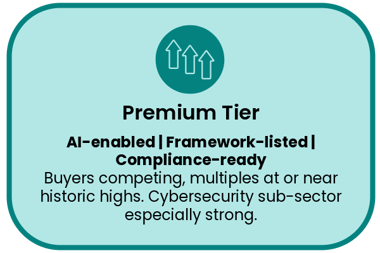
AI integration has bifurcated the market. SaaS companies with embedded, demonstrable generative AI capabilities —
particularly those solving public sector workflow automation, document processing, or predictive analytics challenges — are commanding historic valuation premiums. Those still positioning AI as a roadmap item, or whose datasets are not yet 'AI-ready' are facing buyer scepticism and valuation haircuts.
The Accenture–Faculty deal represents the extreme end of this premium: Faculty's unicorn valuation is rooted in its deep AI expertise and access to government data workflows at the strategic level.
The UK Procurement Act 2023 and a shift toward massive framework agreements have made it harder for SMEs to sell directly. Buyers are consolidating vendors into "one-stop shops," meaning if you aren't on G-Cloud 15, Spark, or partnering with a "Prime," you are effectively invisible to the public sector.
Compliance is no longer a checkbox — it is a barrier to entry. NIS2 (cybersecurity) and the Cyber Resilience Act (CRA) demand "secure-by-design" architectures expensive for lean startups to maintain. Investors now apply a "compliance premium" to firms that can prove regulatory resilience.
Rising compute costs and "AI inflation" are squeezing SaaS margins. As the cost of running LLMs remains high, founders must choose between raising prices — which cash-strapped councils won't pay — or absorbing costs and slowing the path to profitability. Unit economics are under scrutiny.
As seen with the Accenture–Faculty deal, large consultancies are moving from "advisors" to "platform providers." They are building the AI infrastructure your niche SaaS may need to plug into. The risk: SaaS becoming a low-margin "feature" within their high-margin ecosystem rather than a standalone solution.
The "AI bubble" has burst for firms with messy data. Governments now prioritise "Data Readiness" over "AI Flashiness." Founders must spend capital cleaning legacy government data — the "unsexy work" — before deploying their core AI value proposition. This is now a buyer due diligence item.