Discover the CapEQ approach to a premium exit
Whether you're exploring your options or fending off offers, we're here to help.
Published: July 2026 | Reading time: 9 minutes
UK and European ERP and enterprise systems M&A is running at high value on lower volume. European deal value rose 12% in 2025 while transaction counts fell 8%, and that pattern has carried into 2026 — fewer processes, larger cheques, and a sharper line between assets that clear and assets that stall.
International strategics and private equity are the dominant acquirer types on both sides of the Channel. Foreign buyers took 86% of UK M&A by value in the first half of 2026, and add-on acquisitions reached a record 71.4% of European buyouts as sponsors built out platforms in finance, procurement, and operational systems. Financial management software led sector activity at $14.6bn across 17 transactions.
For founders, the takeaway is direct: appetite is strong but conditional. Buyers are underwriting recurring revenue quality, technology debt, and AI exposure with a rigour that did not exist eighteen months ago. Three-quarters of strategic buyers now assess AI impact explicitly in diligence, and 20% have walked away from a transaction because of it.
Median European software M&A multiples sit at 4.1× trailing-12-month revenue, but that median is doing less work than it used to. Well-prepared, AI-credible platforms clear well above it; legacy, on-premise, or founder-dependent businesses clear well below, or do not clear at all. Founders considering an exit in the next one to three years should treat readiness — not market timing — as the primary lever within their control.
Four forces are compounding at once.
The result is resilient, arguably elevated, deal value across the region, concentrated on businesses with proven recurring revenue and a genuine digitalisation strategy already embedded.
Four patterns define the current market, consistently on both sides of the Channel:
| Trend | Description | What we are seeing |
|---|---|---|
| Strategic consolidation | Larger incumbents and global vendors are buying niche analytics, automation, and CFO-suite capability to close product roadmap gaps | OpenText divesting Vertica Analytics to Rocket Software for $150m; portfolio recalibration across the analytics stack |
| AI-led roll-ups | Acquirers are buying to embed automation and machine learning across enterprise platforms rather than build in-house | 72% of SaaS transactions carried explicit AI positioning; finance automation is the most contested sub-sector |
| Add-on and buy-and-build | PE and trade acquirers are assembling UK and cross-border European assets into vertical or pan-European platforms | Add-ons hit a record 71.4% of European buyouts; aggregators such as Valsoft actively acquiring UK SMB SaaS |
| Selective, higher-value dealmaking | Fewer processes, larger average transaction sizes, and greater price discipline | German tech saw 375 deals in 2025, down year-on-year, but deal value up 28% to roughly €16bn |
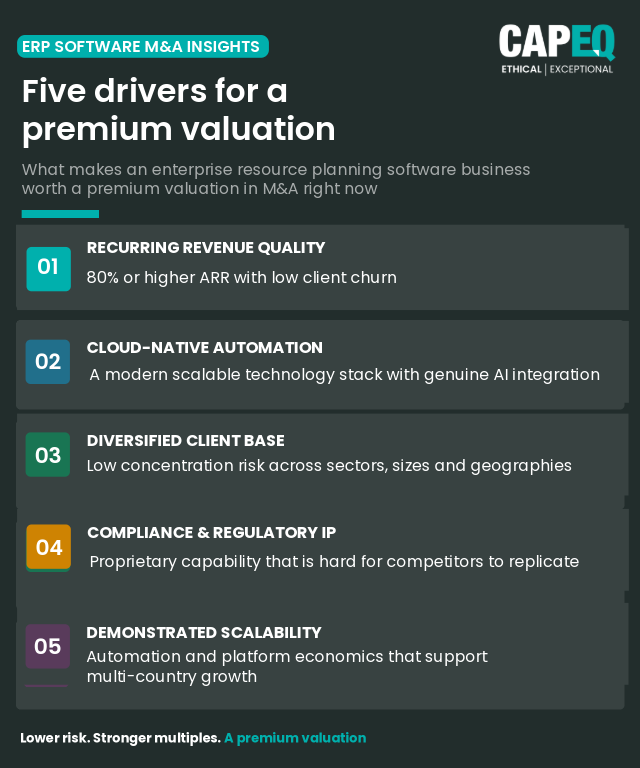
Buyers are paying a clear premium for defensible recurring revenue, quality intellectual property, and demonstrable automation — a pattern consistent across the UK and European markets. Median revenue multiples in European software M&A tracked at 4.1× trailing-12-month revenue over the period, though that benchmark is diverging as AI adoption reshapes how buyers underwrite durability.
The February 2026 "AI rout" knocked software equities by nearly 30%, pushing weaker companies into play and widening the spread between premium and average outcomes. It also cut both ways: a £575m takeover of a listed UK software company collapsed in the same month over AI obsolescence concerns.
Where multiples are disclosed in the sub-£100m band, the range is wide — AIView Group in Italy transacted at approximately 7× EV/EBITDA on preliminary 2025 estimates, while high-growth, highly automated platforms are clearing materially above that with strategic or international acquirers.
The exit decision is rarely driven by a single factor, and the pattern holds across UK and European founders alike. It is the accumulation of six pressures, several of them structural rather than cyclical:
CapEQ advised the shareholders of InfiniteData, the Warsaw developer behind the AutomateNOW! workload automation platform, on its cross-border sale to Berlin-listed Beta Systems Software AG.
The valuation narrative was anchored in product strength, independent analyst ranking, and addressable market rather than trailing revenue alone — the same argument founders now have to make about their AI position. The platform has since been rebranded as the ANOW!® Suite and holds the number one Value Leader position in the 2025 EMA Radar for workload automation.
Direct UK and European ERP and enterprise systems platform transactions above £10m remain largely undisclosed for this period. Publicly reported activity is dominated by international strategics, private equity platforms, and software aggregators. More than 25% of European tech M&A targets in Q1 2026 were SMEs with turnover under €50m, and UK and European deals in the £10m–£90m band form the backbone of overall exit activity. The transactions below are the verified deals with clear UK or European relevance.
| Target |
Target HQ |
Subsector | Deal type |
Acquirer/ investor |
Acquirer HQ |
Enterprise Value |
|---|---|---|---|---|---|---|
| Semine | NO | Finance & accounting | Merger | Rydoo | BE | €85m |
| Pivot | FR | Procurement | Series B raise | Forestay Capital | CH | €35m |
| Foods Connected | UK | Supply chain | Divest 74% | Apax | UK | €25m |
| Amnesto | NO | ERP & Finance | Acquisition | Exsitec | SE | €24m |
| Katana Cloud | EE | Inventory | Series B raise | Cogito Capital | PL | €14m |
| AppXite | LV | Finance & subs | 51% stake | Aries Global | UK | €10m |
| Laberit | ES | Full ERP | Raise | Nazca Capital | ES | €10m |
| Elian | RO | FulL ERP | PE-bolt on | Digmatix | LV | €6m |
| Jakamo | FI | Procurement | Acquisition | Lemonsoft | FI | €6m |
| FasThink | IT | Logistics | Acquisition | TXT e-solutions | IT | €4m |
|
Source: CapEQ analysis of publicly reported transactions, July 2025 – June 2026. Direct continental European transaction data is less consistently disclosed than UK data; this table will be expanded as further verified deals are confirmed. |
||||||
The forward pipeline is strong. Some 56% of surveyed stakeholders expect increased deal activity over the next 12 months, and the next wave is expected to stay concentrated in the SME and mid-market segments.
1. Value will hold up better than volume. Strategic buyers and sponsors are pursuing scale-driven synergies and cross-border expansion rather than volume-led dealmaking. Expect fewer processes, larger average sizes, and more price discipline.
2. Foreign appetite for UK and European assets will stay elevated. US and Asian acquirers in particular continue to read a valuation discount in the region, and currency effects reinforce it.
3. AI diligence will get harder, not easier. Buyers are already walking away over obsolescence risk. Founders should expect direct, technical questioning on where AI helps the product and where it threatens it — and should have an evidenced answer before going to market.
4. Valuation trajectories will keep diverging. Premium multiples are increasingly reserved for cloud-native, automated, vertically specialised platforms. Legacy bolt-ons, sunset portfolios, and founder-dependent businesses will see a widening discount.
5. Private equity add-on activity will remain the dominant structure. With add-ons at a record share of European buyouts, most sub-£100m founders will find their realistic buyer universe includes at least one platform running a live buy-and-build mandate.
6. Regulatory review will shape timing as much as terms. UK merger control reform, tighter foreign direct investment (FDI) scrutiny of AI and digital infrastructure, the EU FDI regime, and new CMA–EU data-sharing protocols all mean pre-signing risk assessment matters earlier in the process than it used to.
7. Preparation will separate premium from average outcomes. Deal failure in this segment is driven more often by poor preparation, valuation gaps, and misaligned objectives than by market conditions — and most acutely among founder-led businesses running a process for the first time.
CapEQ advised the shareholders of Paycircle, a cloud-native payroll platform built for UK bureaus, on its sale to business management software group The Access Group.
Because client churn was very low, the preparatory work anchored the whole valuation narrative on annual recurring revenue rather than earnings — the same argument that separates premium from average outcomes in enterprise systems today.
This report synthesises publicly reported UK and European enterprise software, ERP, and business intelligence transaction data, sector commentary, and CapEQ advisory analysis for the period July 2025 to June 2026.
Verified deal multiples for sub-£100m UK and European enterprise software transactions are not consistently disclosed. Indicative valuation ranges are derived from comparable, publicly reported software and SaaS transactions, and are stated as ranges rather than points where disclosure is partial.
UK transaction data is more consistently disclosed than continental European data. Where European-specific evidence was limited, this report draws on cross-border and pan-European add-on and buy-and-build activity as the clearest available indicator of the wider market.
Notable transactions are limited to publicly confirmed deals with clear UK or European relevance. This report does not constitute investment advice.
 About the author
Mark Sapsford is Co-Founder and Partner at CapEQ, the Certified B Corporation lower mid-market M&A advisory. He has led transactions across technology, industrials, and professional services, and has built and exited businesses of his own.
Read his full bio or book a confidential chat.
Related insights:
International strategic software companies, US and European private equity platforms, and software aggregators pursuing buy-and-build are the most active buyers. Foreign takeovers reached 86% of UK M&A by value in H1 2026, and private equity accounted for 18.6% of all European deals in Q1 2026. Overseas interest is driven by a perceived valuation discount in UK and European assets and by scalable, recurring-revenue business models.
Recurring revenue quality and contract length, a modern cloud-native architecture, credible embedded automation, vertical specialisation, a diversified client base, and low key-person risk. Median European software M&A multiples tracked at 4.1× trailing-12-month revenue over the period, but the spread around that median is wide. Client concentration, legacy technology, and unresolved technology debt reduce achievable multiples in both markets.
Materially, and in both directions. Some 72% of SaaS transactions in the period involved explicit AI positioning, and 75% of strategic buyers assessed AI impact in diligence — with 20% walking away over obsolescence risk. Businesses that can evidence AI as a defensible advantage are attracting a premium. Businesses whose core product looks exposed to AI commoditisation are being repriced or passed over, as the collapse of a £575m UK software takeover in February 2026 showed.
Founder retirement and thin internal succession, the capital intensity of AI and cloud modernisation, an expanding regulatory and compliance load, margin pressure, competition from better-capitalised global platforms, and a desire to de-risk personally. UK SME exit volume rose 11.3% year-on-year to 305 deals over the period.
UK merger control reform and the National Security and Investment regime have increased scrutiny of data-rich technology acquisitions, with particular focus on AI, cybersecurity, and digital infrastructure. Across the EU, the FDI regulation, AI Act, NIS2, and DORA add further diligence and compliance obligations. New data-sharing protocols between the CMA and European authorities are intended to speed cross-border reviews, but pre-signing risk assessment now needs to start earlier in the process.
Prepare early. Deal failure in this segment is driven more often by poor preparation, valuation gaps, and misaligned objectives than by market conditions. Address key-person dependency, technology debt, client concentration, and your AI position well before entering a process. Specialist M&A advice helps you anticipate buyer questions, defend value, and avoid surprises in diligence.