
UK acquisitions can compress years of growth into months — yet research shows 70-90% destroy value when strategic discipline lapses entirely.
Series: M&A activity insights · Acquisition strategy · Last updated: June 2026
10 Reasons to Acquire Another Business: A UK Strategy Guide
The Gist
- Acquisitions can deliver in months what would take years to build organically — entering new markets, adding capability, or consolidating share.
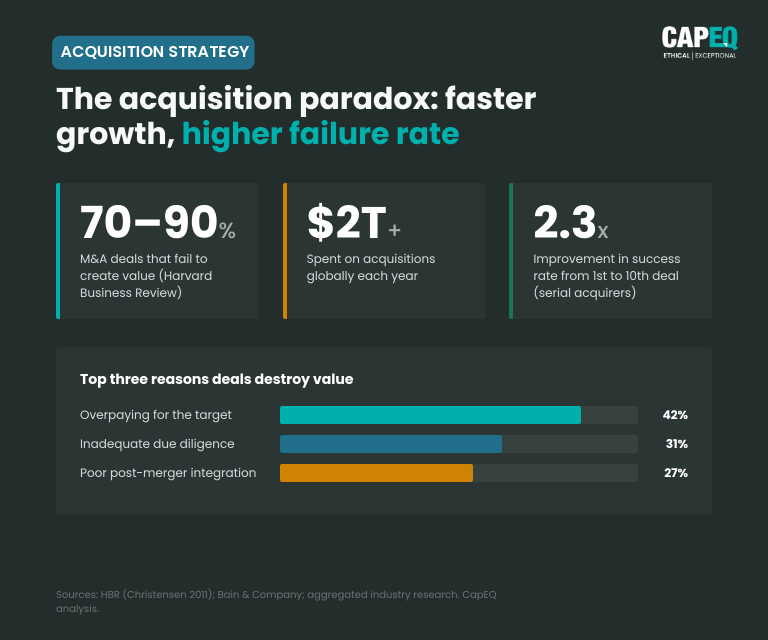
- Harvard Business Review's long-standing analysis puts the M&A failure rate at 70-90%, with overpayment, weak due diligence and poor integration the three most cited causes.
- Companies that approach M&A as a repeatable discipline outperform first-time acquirers materially: research suggests success rates roughly double between a buyer's first and tenth deal.
- The ten reasons UK firms most commonly cite for acquiring are market expansion, diversification, economies of scale, market share, technology, talent, financial synergies, risk mitigation, regulatory access and roll-up exit.
- Strategic rationale only justifies the deal; integration delivers it. Every reason below comes with a corresponding integration burden that must be planned before signing.
Acquiring another business is one of the fastest ways to grow — and one of the easiest ways to destroy value. The Harvard Business Review's research into M&A outcomes, drawn from Clayton Christensen and colleagues' analysis of decades of deals, puts the failure rate at somewhere between 70 and 90 per cent. That doesn't mean acquisitions don't work. It means the ones that do work share a common trait: the acquirer was clear, before negotiations started, on which of the ten reasons below justified the deal — and was honest about which did not.
This guide sets out the ten strategic reasons UK businesses most commonly cite for acquiring another company, the trade-offs each one carries, and the integration discipline that determines whether the reason holds up in practice.
Why acquire at all?
Organic growth is cheaper, lower-risk and easier to control. Acquisition is faster, scalable and — done well — the only way to enter certain markets, sectors or capability sets within the timeframes investors and customers expect.
The question is rarely "should we acquire?" in the abstract. It is "what is this specific deal expected to deliver that we cannot deliver another way, and at what cost?" If a leadership team cannot answer that question in one sentence, the deal is not ready.
The 10 reasons UK businesses acquire
1. Market expansion: a shortcut to new geographies
For UK firms looking to enter a new region, country or customer segment, acquisition compresses what would otherwise be a multi-year build. Buying a target with an established presence delivers premises, staff, supplier relationships, regulatory permissions and brand recognition on day one.
The trade-off is integration cost. New geographies bring new tax regimes, employment law, cultural conventions and — for cross-border deals — currency exposure. Acquirers who treat geographic expansion as primarily a sales-channel decision tend to under-invest in the operational integration that makes the channel work.
In practice: When rail consultancy Travel Point Trading was acquired by Amey UK plc, the strategic logic was deepening capability in the UK rail market — a sector where regulatory familiarity, framework relationships and security-cleared staff matter more than headcount. Acquisition delivered all three within a single transaction.
2. Diversification: building resilience against single-sector risk
Acquiring outside your core product or service line spreads exposure. If one division is hit by a cyclical downturn or a regulatory shift, others can carry the group through.
The honest version of this argument is narrower than it sounds. True diversification — moving into a genuinely different market with a different customer base, supply chain and economics — is also where most acquirers struggle most. They underestimate the management bandwidth required to run something they don't deeply understand. Adjacent diversification (a new product line for existing customers, or an existing product for new customers) tends to deliver better outcomes than headlong jumps into unfamiliar territory.
3. Economies of scale: cost discipline through combination
Larger combined operations can negotiate better supplier terms, consolidate overhead and spread fixed costs across more revenue. This is the most quantifiable acquisition rationale, which is why it dominates banker pitch decks.
It is also the easiest to overstate. Cost synergies are typically delivered late, delivered partially, or delivered alongside revenue dis-synergies that nobody modelled — customers leaving when their account manager changes, suppliers re-pricing when volume terms get renegotiated, key staff exiting during integration. Conservative synergy modelling — what CapEQ partners refer to as building the case below the synergy line — is the discipline that separates buyers who hit their plan from those who don't.
4. Market share: consolidating a position
Acquiring a direct or near-direct competitor removes a rival, adds their customers, and increases pricing power. In fragmented sectors with strong consolidation logic — UK accountancy, electrical contracting, dental, fire safety, MSPs — this is often the dominant strategic rationale.
Competition law applies. Most SME deals fall well below merger control thresholds, but acquirers building toward sector dominance should take regulatory advice before the deal that crosses the line.
5. Technology and capability: buying what you can't build
For a buyer facing a technology gap, an acquisition can be faster, cheaper and lower-risk than internal R&D. This is most acute when the target holds proprietary IP, a difficult-to-replicate engineering team, or a market-tested product that would take years to develop from scratch.
CapEQ in practice: When $2.7bn PR-tech group Cision acquired social media monitoring platform Factmata in 2022, the rationale was capability acceleration. Cision needed AI-driven sentiment analysis to keep pace with how its enterprise customers were measuring earned media. Building that capability internally would have taken years; Factmata's team and IP delivered it in a single transaction.
6. Talent: the acquihire route
In sectors with severe skills shortages or nascent technical disciplines, acquiring a company can be the only realistic way to bring in a critical mass of qualified people. This pattern is most visible in engineering consultancy, specialist software, regulated healthcare and defence.
Acquihires are also the deals most likely to disappoint. The talent you are buying can leave. Retention packages, restrictive covenants, IP assignments and — for transfers of part of a business — TUPE protections all need to be in place before the deal closes, not negotiated afterwards.
7. Financial synergies: profit, not just revenue
A well-chosen target adds profit, not just turnover. Acquisitions that bring higher-margin revenue streams, recurring revenue, or operational gearing can lift group EBITDA disproportionately to the headline price paid.
The discipline here is to separate genuine financial synergy — re-rating the combined group on a sustainable basis — from one-off accounting effects that flatter the first set of post-deal numbers but unwind within twelve months.
8. Risk mitigation: reducing concentration
Acquiring revenue in a different segment, customer base or geography reduces the impact of any single market downturn. For owner-managed businesses with concentrated customer or sector exposure, this is sometimes the most important strategic reason — even if it does not generate the most exciting board paper.
9. Regulatory access: buying the licence as well as the business
In industries with high regulatory barriers — waste management, healthcare, financial services, defence, telecoms, aviation — established relationships with regulators are themselves a form of intangible asset. Acquiring a compliant operator can be faster and cheaper than building compliance from scratch.
CapEQ in practice: Asker Healthcare Group's acquisition of Health Net Connect, and Wernick Group's acquisition of modular building specialist AV Danzer, both demonstrate this pattern. In each case, the acquirer was buying not just operational capability but enhanced accessibility in a regulated supply chain.
10. Exit strategy: building toward a roll-up sale
For some owners, the long-term plan is to assemble a group through acquisition and sell it as one — capturing a valuation multiple uplift that the constituent parts could not reach individually. UK accountancy demonstrates this clearly: Baldwins assembled seven firms before merging into Cogital Group with around 30 others, eventually rebranding as Azets and reaching a scale that supported a much larger exit than any single firm could have achieved.
This strategy is real, but demanding. It requires institutional integration capability, patient capital, and an exit timeline that the owners can credibly hold through multiple deal cycles.
What this looks like in practice: a discipline, not an event
Across CapEQ's transaction history — from Wernick acquiring AV Danzer to Cision acquiring Factmata — the deals that delivered on their strategic rationale shared a common pattern. The acquirer was clear on which of the ten reasons above the deal was justified by. They modelled the synergies conservatively. They planned integration before signing. And they treated the close of the deal as the start of the work, not the end of it.
The deals that disappoint share an equally consistent pattern. Strategic rationale was assembled retrospectively to justify a target that the buyer was already emotionally committed to. Synergies were modelled to make the price work, not to reflect what was achievable. And integration was something the operating team would "sort out" after completion.
Framework: matching the reason to the integration burden
| Acquisition reason | What it delivers fastest | Where integration most often fails |
|---|---|---|
| Market expansion | Geographic footprint, customers, permissions | Tax, employment law, cross-border management |
| Diversification | Revenue spread, sector exposure reduction | Management bandwidth in unfamiliar markets |
| Economies of scale | Procurement, overhead consolidation | Revenue dis-synergy from customer churn |
| Market share | Consolidation, pricing power | Competition law, brand cannibalisation |
| Technology / capability | IP, engineering teams, products | Tech-stack integration, IP transfer mechanics |
| Talent (acquihire) | Skilled headcount, leadership | Retention, restrictive covenants, TUPE |
| Financial synergies | Margin uplift, recurring revenue | One-off effects mistaken for sustainable gains |
| Risk mitigation | Reduced concentration exposure | Diluted management focus |
| Regulatory access | Licences, accreditations, relationships | Maintaining compliance post-integration |
| Roll-up exit | Multiple uplift on combined group | Sustained integration capability over years |
Pro tip from Lee Robbins, Director at CapEQ: "If you can't articulate which one of the ten reasons your deal is primarily justified by — and which two or three it isn't — you're not ready to negotiate price. Buyers who pick the rationale during the deal almost always overpay for the wrong things."
The pre-acquisition checklist
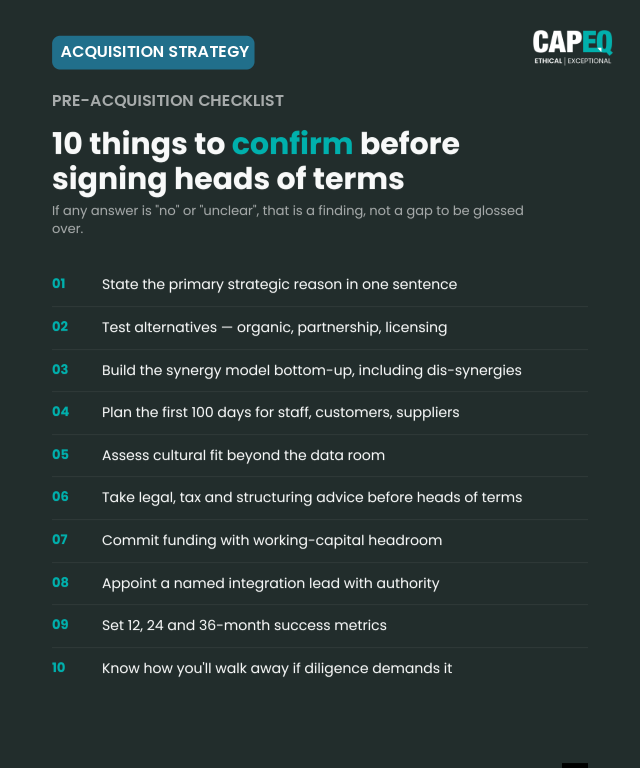
Before signing heads of terms on any acquisition, work through every item below. Where the answer is no or unclear, that is a finding, not a gap to be glossed over.
- We can state, in one sentence, the primary strategic reason this deal is being pursued.
- We have considered organic, partnership and licensing alternatives, and acquisition is genuinely the best option.
- Our synergy model is built bottom-up, includes likely revenue dis-synergies, and has been stress-tested by someone outside the deal team.
- We know what we will do with the target's leadership, key staff, customers and suppliers in the first 100 days post-completion.
- Cultural fit has been assessed beyond the data room — through site visits, customer references and informal conversations with the target's team.
- We have legal, tax and structuring advice in place before heads of terms, not afterwards.
- Our funding is committed, with sufficient headroom to absorb working-capital surprises post-completion.
- We have a named integration lead — not the deal lead, not the CEO — with the authority and bandwidth to deliver the post-deal plan.
- We have a defined timeline and budget for integration, with realistic milestones tied to synergy delivery.
- We know what success looks like in 12, 24 and 36 months — and we know how we'll walk away from the deal if due diligence reveals it cannot.
Frequently asked questions
What is the most common reason to acquire another business? The most common reasons UK acquirers cite are market expansion, capability or technology access, and consolidation of market share. Which of these dominates depends heavily on the buyer's sector and stage. Growth-stage technology firms acquire most often for capability; established services firms acquire most often for geography or share consolidation. CapEQ's experience across lower mid-market UK transactions suggests the strongest deals are those with one clearly dominant strategic reason, not those that try to justify themselves on three or four reasons simultaneously.
What percentage of acquisitions fail? Harvard Business Review's analysis, drawing on Clayton Christensen's research, puts the M&A failure rate at between 70 and 90 per cent — though "failure" in this context spans deals that underperform their synergy targets, deals that destroy shareholder value relative to peers, and deals that are divested within five years. More recent Bain & Company research suggests serial acquirers since 2004 succeed roughly 70 per cent of the time, indicating that experience, repeatable process and integration discipline materially shift the odds. Either way, the implication is the same: acquisition is a discipline, not an event, and the buyers who get good at it are the ones who treat each deal as part of a longer institutional learning curve.
Should I acquire a competitor or a complementary business? Both can work. Acquiring a direct competitor delivers fastest on market share, pricing power and cost synergies, but carries higher integration risk because two near-identical organisations must merge cultures, customers and overlapping teams. Acquiring a complementary business — a different product line, customer segment or geography — delivers slower on cost synergies but tends to preserve more of the target's value because there is less overlap to rationalise. The right choice depends on the buyer's appetite for integration risk and the strength of their integration capability.
How long does it take to integrate an acquisition? Most CapEQ-advised acquisitions show the bulk of integration value being delivered between 12 and 24 months post-completion, with the first 100 days disproportionately important for setting the tone with staff and customers. Quick-win integration — combining back-office functions, consolidating suppliers, rationalising property — typically completes within 6 to 9 months. Deeper integration of systems, brands and product lines often takes 18 to 36 months. Acquirers who try to compress this timeline aggressively risk losing key staff and customers; acquirers who extend it indefinitely risk never delivering the synergy case.
What's the difference between a strategic acquisition and a financial acquisition? A strategic acquisition is one made by an operating business expecting to integrate the target into its existing platform and extract operational, commercial or capability synergies. A financial acquisition — most commonly by a private equity buyer — values the target on its standalone cash generation potential and exit value, without expecting to integrate it into a larger group.
Strategic buyers can usually justify higher prices because of synergy capture; financial buyers compete on speed, certainty and lighter integration disruption for the seller. Founders considering acquisition as a route to exit should understand which buyer profile their business will appeal to, because the deal dynamics, valuation logic and post-deal experience are very different.
Do small businesses make good acquisition targets? Yes — and the UK lower mid-market is where most of the best risk-adjusted acquisition opportunities sit. Owner-managed businesses in the £5m–£25m enterprise value range are large enough to be operationally meaningful to an acquirer, small enough to be priced reasonably, and often run by founders ready to exit or to step back. The challenge is identification: there is no public deal flow at this end of the market, which is why acquirers serious about buy-and-build typically work with an advisory firm to source proprietary opportunities rather than waiting for businesses to come to market.
About the author
 Lee Robbins is Director and Head of Research at CapEQ, joining the firm in 2021. He leads CapEQ's transaction origination and research programmes, working with both acquisitive groups and founders preparing for exit across the UK mid-market. He authors CapEQ's research on acquisition strategy, post-merger integration and growth capital.
Meet the CapEQ team or book a confidential chat to discuss your acquisition strategy.
Related articles
- M&A Done Right: 7 Steps to a Transformative Acquisition
- Post-Merger Integration: The Acquirer's Practical Guide to Protecting Deal Value
- The Five Types of Acquisition Synergies — and How to Model Them
- Scarcity Premium: Why Some Businesses Sell for Multiples Others Can't Reach
- Venture Debt vs Equity: Choosing the Right Growth Capital