Discover the CapEQ approach to a premium exit
Whether you're exploring your options or fending off offers, we're here to help.

An unresolved shareholder dispute will derail your sale — here is the practical guide to fixing it before going to market.
Shareholder disputes are one of the fastest ways to derail a business sale. Buyers read them as red flags in due diligence — signals of governance risk, valuation gaps, and post-deal headaches. The fix is to settle them before you go to market. That means a current shareholders' agreement, clear exit and transfer rules, defined decision-making processes, and a route to mediation if things stall. Get these in place early and you protect both your valuation and your sanity through the sale.
We see it more often than you would think. A founder spends 15 years building something brilliant, lines up a great buyer, and then a co-shareholder no one had spoken to properly in five years suddenly finds their voice. By that point, the buyer has noticed. So has their lawyer.
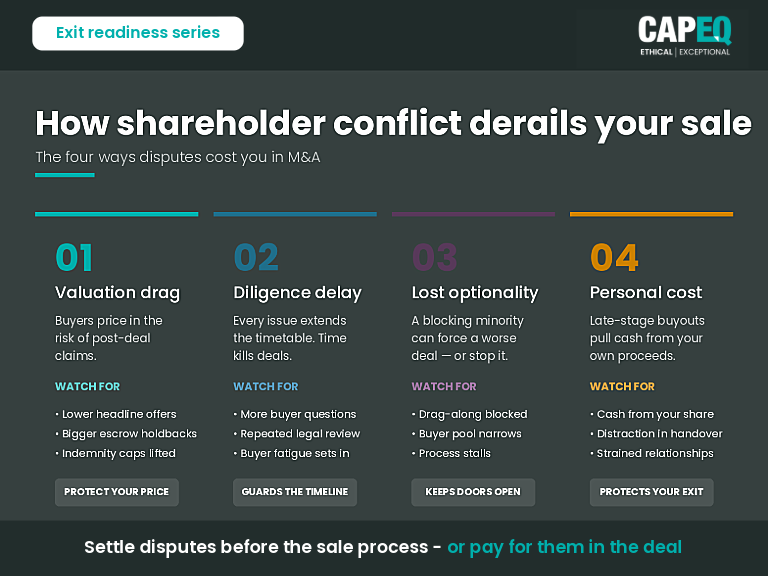
Unresolved shareholder issues affect a sale in four big ways:
| Impact | What it looks like in practice |
|---|---|
| Valuation drag | Buyers price in the risk of post-deal claims, often by reducing offer or increasing escrow. |
| Due diligence delay | Every unresolved issue extends the timetable, and time is the enemy of every deal. |
| Lost optionality | A blocking minority can stop a sale completely, or force a worse outcome to clear them out. |
| Personal cost | Late-stage buyouts pull cash from your own proceeds and dominate the months that should be your handover. |
We have worked through these moments many times. For example, when Really Simple Systems joined the Spotler group, the exit needed to work for founders, team, and incoming owners alike. The pattern is consistent: the deals that close cleanly are the ones where the shareholder house was in order before the buyer ever walked through the door.
A well-drafted shareholders' agreement is the foundation. It sets out the rights, responsibilities, and obligations of everyone on the cap table. It is the document a buyer's lawyer will read first, and the one that prevents most disputes in the first place.
If your agreement is more than three years old, or if it has not kept up with how the business has actually changed, it needs a refresh. Here is what good looks like.
Define who does what. One shareholder might run sales and marketing. Another might own finance and operations. Clarity here reduces friction in the day-to-day, and it gives a buyer a clean picture of how the business actually runs.
Set the policy for dividends and reinvestment. Most disputes about money start because no one wrote down the rule when everyone was still getting on. Write it down.
Spell out how big calls get made. Simple majority for routine decisions. Supermajority — often 75% — for things like a sale, a fundraise, or a change of strategy. Buyers like to see this, and your future self will too.
Even with the best plan, things wobble. A dispute resolution clause sets out how disagreements are handled — typically mediation first, then arbitration, with court as a last resort. Including this clause is not pessimistic. It is the kind of grown-up planning that keeps relationships intact when they matter most.
Quick tip: Review your shareholders' agreement every two years, and after any change in ownership, role, or strategy. The agreement you signed at incorporation is unlikely to fit the business you have now.
This is the bit that catches a lot of founders out, so it is worth being clear.
Good leaver and bad leaver provisions decide what a shareholder gets when they exit. Good leavers — typically retirees, or those leaving by mutual agreement — usually receive full market value. Bad leavers — those who are dismissed for cause, or who breach their employment terms — receive a discounted price, sometimes a heavy discount.
The 2024 case of Moxon v Litchfield confirmed that well-drafted bad leaver provisions are enforceable, even where the discount feels harsh. Two practical points fall out of this:
Reserved matters are the decisions that need shareholder approval regardless of how the votes split — issuing new shares, taking on significant debt, selling material assets, changing the company's purpose. They give minority shareholders a voice on the things that actually matter, which in turn reduces the risk of someone feeling sidelined and starting a fight.
Different share classes can serve a similar purpose. Some shareholders may have voting rights. Others may have preferential dividend rights. Drafted clearly, this works well. Drafted vaguely, it is a future dispute waiting for its moment.
For more complex boards, an independent director can hold the ring. Someone with no shareholding has no axe to grind, which makes them a useful counterweight when the room gets tense.
A lot of disputes happen at the moment of exit. Without clear rules, this is when things get expensive.
A buy-sell agreement covers what happens when a shareholder dies, retires, or wants out. It sets the process and the price. It is one of the most undervalued documents in private company life.
Pre-emption rights give existing shareholders first refusal on shares before they go to anyone outside. This protects the cap table from unwelcome surprises and keeps control where it belongs.
Most exit disputes come down to price. Set the valuation method in advance — independent valuation by a named firm, or a pre-agreed formula tied to earnings. Argue about the method when no one is leaving. It is a much easier conversation.
Routine business decisions — simple majority. Strategic shifts (sale, restructure, dilution) — supermajority. Spelling this out keeps the day-to-day moving and reserves big decisions for genuine consensus.
A 50/50 split is a deadlock waiting to happen. Build in a tie-breaker — an independent advisor with a casting vote, or a defined escalation route. Anything but stalemate.
Despite the best-laid plans, sometimes shareholders fall out. When that happens, get to mediation early. The Centre for Effective Dispute Resolution reports that around 93% of mediations resolve on the day or shortly after. Litigation, by contrast, can run for years and consume the very value you are trying to protect.
| Route | Speed | Cost | Relationship | Outcome |
|---|---|---|---|---|
| Mediation | Weeks | Lower | Often preserved | Negotiated, voluntary |
| Arbitration | Months | Mid | Strained but workable | Binding, private |
| Litigation | 1 to 3 years | High | Usually terminal | Public, binding, blunt |
If a shareholder is also a director and the relationship has become untenable, removing them as a director is a separate process from removing them as a shareholder. The Companies Act 2006 sets out the steps — special notice, a general meeting, an ordinary resolution — and you must follow them precisely. And remember: a former director can still be a current shareholder. Director removal does not change the cap table.
This is the kind of moment where good legal advice is essential. We are happy to introduce you to firms we know and trust.
If you are 12 to 24 months from a sale, here is the shortlist: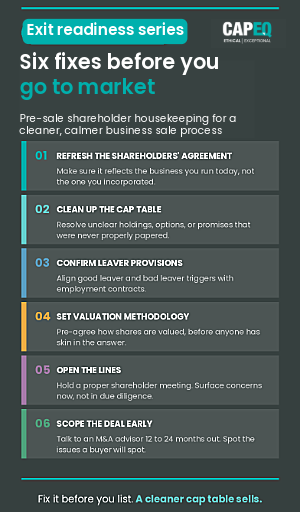
No one selling a business wants to be buying out minority shares in the middle of due diligence demands. Get this work done now and the sale itself becomes a much calmer experience.
A shareholders' agreement is a private contract between the owners of a company. It sets out who can do what, how decisions get made, what happens if someone leaves, and how disputes are handled. It sits alongside the Articles of Association, which is the public-facing rulebook filed at Companies House.
Not usually. But your shareholders' agreement and Articles can include compulsory transfer provisions or share buyback clauses that trigger on certain events, such as a director-shareholder being dismissed, or a shareholder becoming insolvent. Without those provisions, a forced sale is very difficult to achieve.
If you reach mediation, often a few weeks to a few months. If it ends in litigation, 12 to 36 months is common, sometimes longer. The cost difference is usually an order of magnitude, which is why we always encourage early dialogue.
It depends on your agreement. Drag-along rights let majority holders pull minority shareholders into a sale on the same terms. Tag-along rights let minority holders join a sale by the majority. Without these, a single dissenting shareholder can complicate or block a deal entirely.
Yes — every time. Buyers price in unresolved risk, due diligence stalls, and the cost of fixing it under deal pressure is always higher than fixing it in advance. Twelve to 24 months ahead of a sale is the right window.
A note on advice: This article is general guidance, not legal advice. Shareholder disputes are fact-sensitive, and your situation deserves proper professional input. We work alongside several excellent law firms and are happy to introduce you.

Mark Sapsford is a Partner at CapEQ, a B Corp-certified mid-market M&A advisory firm. He has spent over two decades guiding founders and shareholder groups through sale processes, with particular focus on the human side of getting deals done.