Discover the CapEQ approach to a premium exit
Whether you're exploring your options or fending off offers, we're here to help.

Selling your business is one of the biggest decisions of your working life — and one of the most sensitive. If word gets out too early, staff start updating their CVs, customers ring competitors, and the value you have spent years building can begin to unravel overnight. The good news: with the right advisor and a clear plan, you can run a competitive sale process and keep it almost entirely confidential until you choose to go public. This is how.
The Gist
Most founders underestimate how quickly news of a sale travels. A conversation overheard in a meeting, a LinkedIn change spotted by a supplier, a buyer who mentions it to a mutual contact — any of these can set off a chain of events that is hard to reverse.
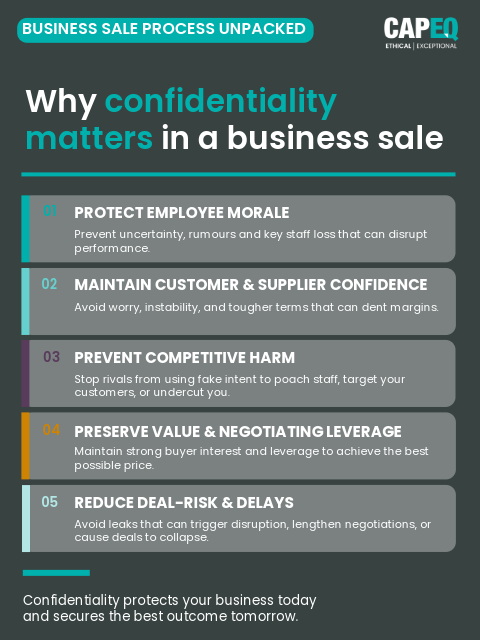
The consequences are real:
Research from SS&C Intralinks (with Bayes Business School) tracking M&A deal leaks over a 14-year period found that leaks affect not just the timing of deals, but the economics — the price paid and the negotiating leverage on both sides. Confidentiality is not a box to tick. It is a commercial priority.
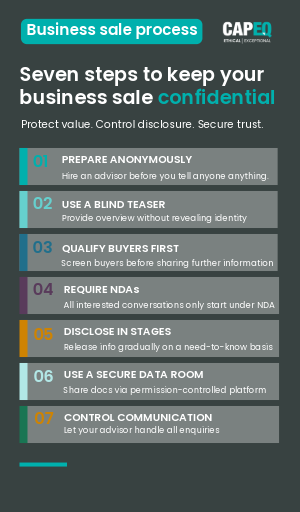
The single biggest mistake sellers make is sharing too much too soon — either because they are eager to show the business in its best light, or because they lack the structure to hold back. A well-managed sale process releases information in stages, each one gated behind a meaningful commitment from the buyer.
| Stage | What you share | Who sees it | Gate |
|---|---|---|---|
| Blind teaser | Industry, approximate revenue, region only | Any interested party | None — no identity revealed |
| After NDA signed | Confidential Information Memorandum (CIM) — financials, team, operations | Pre-qualified buyers only | Signed non-disclosure agreement (NDA) |
| After letter of intent (LOI) | Full due diligence pack — contracts, IP, HR, customer data | Preferred buyer only | LOI signed, exclusivity agreed |
| After exchange | Remaining sensitive data — key customer contacts, supplier pricing | Buyer and legal teams | Solicitors managing transfer |
| Completion | Employees, customers, press informed | All stakeholders | Deal signed and announced |
In practice: the Factmata sale
When Factmata CEO Antony Cousins worked with CapEQ to sell the AI analytics business to PE-backed Cision, the process ran over nine months. Throughout that time, Antony maintained transparency with his team — but on his own terms and timeline, not as a result of a leak. By the time the deal was announced, all seven developers had been redeployed within Cision. While unusual, keeping key talent was critical to a successful sale.
A non-disclosure agreement (NDA) is the first formal gate in any sale process. It is the document a potential buyer signs before they see your business name, your financials, or any identifying detail. It sets the tone for the transaction and signals that you are well-advised.
An NDA is a legal agreement — not a guarantee. If a determined buyer, competitor, or employee wants to act on information they have received, enforcing an NDA takes time, money, and proof of breach. That is why the operational controls around an NDA matter just as much as the document itself.
One-way or mutual? In most mid-market sales, the NDA is one-way: only the seller is disclosing sensitive information, so only the buyer is bound. If you are exploring a merger, or if the buyer is also sharing commercially sensitive data with you, a mutual NDA (binding both sides equally) is appropriate. Some buyers — particularly private equity firms — will resist mutual NDAs. A good advisor will navigate this without conceding material protection.
 confidentiality: beyond the paperwork
The mechanics of confidentiality go well beyond a signed document. An experienced M&A advisor will build a set of operational controls into the process from the start.
The initial approach to potential buyers describes the business — its sector, approximate size, geographic footprint — without identifying it. No name, no website, nothing that a quick Google could trace back to you. Buyers are qualified and filtered before anything sensitive is shared.
Rather than approaching a wide field, a good advisor curates a targeted list of genuinely suitable buyers. Fewer people in the loop means fewer opportunities for leaks. If a direct competitor needs to be approached — for example, because they represent the most logical strategic acquirer — the information they see is carefully edited before the NDA is countersigned.
Once a sale is progressing, a virtual data room (VDR) provides a secure, access-controlled environment for due diligence documents. You can see exactly who has viewed each document, when, and for how long — and revoke access instantly if a buyer drops out. Watermarked documents add an additional deterrent against misuse.
For sensitive transactions, it is common practice to use a project code name internally and in external communications, minimising the risk of emails or documents being identified if they are seen by the wrong person.
The fewer people who know about a sale, the lower the risk. Your advisor will guide you on who needs to be brought into the conversation at each stage. Typically, that means you, your co-founder (if any), your lawyer, and your accountant — and, later, a small number of key managers whose cooperation is essential for due diligence.
There is a growing risk that most founders have not considered: artificial intelligence (AI) notetaker applications.
These tools — which join calls as a participant, record the meeting, and generate transcripts and summaries — are increasingly common in business settings. They are used by advisors, buyers, lawyers, and intermediaries. The problem is that those transcripts and summaries are typically stored on third-party servers, sometimes used to train AI models, and subject to the data policies of companies you have never heard of.
During a confidential sale process, your conversations are among the most commercially sensitive you will ever have. Detailed financials, strategic vulnerabilities, staff concerns, pricing logic — all of it may be captured by an AI notetaker in a meeting with a buyer or their advisors, without your explicit consent.
What to ask your advisor
Before you begin a sale process, ask your M&A advisor whether they have a formal AI policy that covers notetaker applications. Ask who they permit to record calls, whether they use AI transcription tools themselves, and how any transcripts are stored and deleted. If they do not have a clear answer, that is itself a signal worth taking seriously.
This is not about being anti-technology. AI tools can be genuinely useful in M&A — for research, analysis, and deal management. But their use during confidential conversations requires explicit governance. At CapEQ, we ask all parties to agree to meeting protocols before any sensitive call takes place, and we do not permit the use of AI notetaker applications in sale process discussions without the informed consent of our clients.
Even well-managed processes occasionally spring a leak. A rumour starts. A supplier mentions something they should not know. A former employee posts something ambiguous on LinkedIn. This is not the end of the process — but it does require a swift, calm response.
Your advisor should prepare a short-form communications plan at the outset — covering what you would say to employees, customers, and suppliers if the sale became known before completion. Having this ready means you are responding, not reacting.
The goal is to reduce anxiety without confirming or denying specifics. Most employees and customers accept this if it comes from a trusted source and is delivered calmly. The worst outcome is silence — which fills with speculation.
As late as practically possible, and after completion wherever you can. For most mid-market sales, the management team is only brought in during due diligence — typically three to four months before completion — and the wider team is told after the deal signs. Work with your advisor to prepare a joint announcement with the buyer that puts a positive frame on the transition from day one.
Not necessarily, and not early. Your advisor and solicitor will guide you on the timing of bank notifications. Telling your bank too soon can complicate financing arrangements and raise unnecessary questions. In most cases, banks are informed as part of the formal change-of-control process, which happens close to completion.
This is more common than you might think. A direct approach from a competitor can be genuinely attractive, but it carries the highest confidentiality risk of any sale scenario. Before sharing anything, get an NDA signed that has been reviewed by your own legal advisor — not the buyer's template. And consider whether you want to use the approach to run a parallel process with other buyers. Exclusivity is a concession — do not give it cheaply.
Not entirely. An NDA prevents explicit disclosure and misuse of your confidential information, but proving that a competitor used your data to inform their strategy is genuinely difficult. The most effective protection is a well-structured process that limits what each buyer sees, when they see it, and gives you audit trails through a virtual data room.
Confidentiality in a business sale is not about secrecy for its own sake. It is about protecting the value you have built, giving you control over your own story, and ensuring that the people who matter most — your team, your customers, your suppliers — hear the news from you, on your terms.
The businesses we have sold at CapEQ have ranged from AI-driven software to global healthcare and specialist manufacturing. In every case, a structured approach to confidentiality has meant that when the announcement came, it was a moment of pride — not damage limitation.
If you are thinking about a sale — even years away — we would be happy to talk through how a confidential process works in practice. No commitment, no pressure, just a straight conversation.

James Pugh is a Partner at CapEQ, the Certified B Corporation mid-market M&A advisory. He has led transactions across technology, healthcare, manufacturing, and professional services over a 15-year M&A career. Read his full bio or book a confidential chat.
This article is part of our Business Sale Process Unpacked series. Helpful further reads: