Discover the CapEQ approach to a premium exit
Whether you're exploring your options or fending off offers, we're here to help.

Understand normalised EBITDA before you sell: where price rests on an EBITDA multiple, this financial work materially moves deal value.
Series: Business valuation · M&A Valuation Drivers · Last updated: September 2026
Written by Vera Littova, Corporate Finance Manager at CapEQ | Originally published: 9 September 2026
- Normalised EBITDA is the earnings figure a buyer will actually accept – not the highest number a seller can present.
- At a 6x multiple, a single £200,000 add-back moves the deal value by £1.2 million.
- Buyers test every adjustment through a Quality of Earnings (QoE) review before a deal completes.
- Standard adjustments – owner costs, one-offs – are usually expected; judgement-call add-backs invite negotiation.
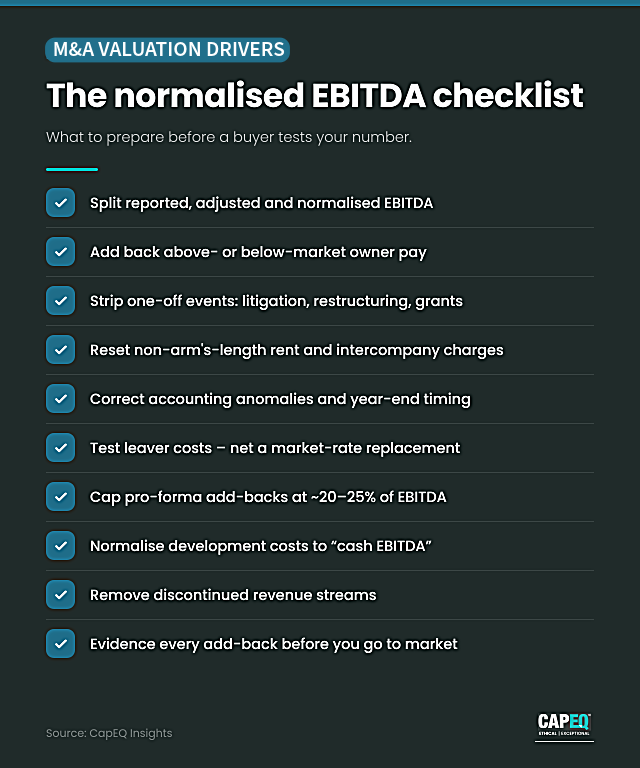
- Lenders commonly cap pro-forma add-backs at around 20–25% of EBITDA.
When buyers, lenders, or investors assess a company, headline profits rarely tell the whole story. That's where normalised EBITDA comes in – a measure designed to show what a business genuinely earns under typical conditions, stripped of noise.
EBITDA is already a popular proxy for operating cash generation. Normalised EBITDA goes a step further by adjusting for items that are one-off, non-recurring, or not reflective of how the business would run under new ownership. The aim is simple: present a sustainable, repeatable earnings base. It helps to separate three versions of the same metric: reported EBITDA (straight from the accounts), adjusted EBITDA (the seller's proposed add-backs) and normalised EBITDA (the figure a buyer will actually accept once each adjustment has been tested). (In US usage the same measure is written normalized EBITDA.)
Some normalisations are so well established that diligence teams expect to see them:
A second tier of adjustments has become increasingly common, but each one invites negotiation rather than automatic acceptance:
Pro tip from Vera Littova, Corporate Finance Manager: Build the evidence for every judgement-call add-back before you go to market, not when the buyer's Quality of Earnings team asks for it.
A one-page memo per adjustment – what it was, why it won't recur, and where it sits in the accounts – is what turns a contested add-back into an accepted one.
In M&A, valuations are frequently built on a multiple of EBITDA. A £200,000 adjustment at a 6x multiple shifts the price by £1.2 million – so normalisation isn't an academic exercise; it directly moves the deal value. Buyers and their advisers work through an EBITDA bridge – a line-by-line reconciliation from reported to normalised EBITDA – and the figure that survives that bridge is the one the price is built on. Lenders also use normalised figures to size debt facilities and test covenants, which is precisely why credit agreements increasingly cap the add-backs they will accept.
Adjustments cut both ways. Sellers naturally push for add-backs that flatter earnings, while diligence teams scrutinise each one for substance. Credible normalisations are well documented, clearly non-recurring, and defensible under challenge. Aggressive or vague add-backs erode trust quickly – and can do more damage to a process than the EBITDA they add.
Done properly, normalised EBITDA bridges the gap between what the accounts say and what the business truly delivers – and that clarity benefits everyone at the table. This is why the work belongs before a sale process begins, not midway through it. Once a buyer is in exclusivity a seller's bargaining position narrows, and add-backs that were never properly evidenced are the easiest place for a buyer to reopen – or re-trade – the price.
What is normalised EBITDA? Normalised EBITDA is a company's EBITDA adjusted to show the earnings it genuinely generates under normal ownership and trading conditions. It strips out one-off, non-recurring and owner-specific items so that buyers, lenders and investors can see a sustainable, repeatable earnings base rather than a figure distorted by unusual events. In an M&A process it is the number a buyer is trying to trust, because the purchase price is usually built on a multiple of it.
What is the difference between adjusted and normalised EBITDA? Adjusted EBITDA is usually the seller's proposed view – reported EBITDA with the add-backs management believes are justified. Normalised EBITDA is the figure that survives scrutiny: the adjustments a buyer will actually accept once each has been tested for evidence, recurrence, and the cost of replacing whatever is being removed. The gap between the two is where most price negotiation happens.
Does normalised EBITDA include the owner's salary? It includes the market cost of the owner's role, not necessarily the amount the owner is currently paid. If a founder pays themselves above the market rate for the job, the excess can usually be added back. If they pay themselves below market, or take profits as dividends instead of salary, a buyer will often make a negative adjustment to reflect what it would cost to replace them. The test is always the cost of a like-for-like replacement after the sale.
Why would a buyer reduce my EBITDA during a sale? Because the buyer is underwriting the earnings it expects to own after completion, not the earnings the accounts happen to show today. During due diligence a buyer will challenge any add-back that looks recurring, poorly evidenced or dependent on future actions, and may reclassify or reverse it. Some adjustments – particularly capitalised development costs in software businesses – commonly move the figure down rather than up. A reduction in normalised EBITDA feeds straight through to a lower price at the agreed multiple.
When should I prepare my normalised EBITDA? Before you go to market, not midway through a live process. Once a buyer is in exclusivity your bargaining position narrows, and any add-back that was never properly documented becomes the easiest place for a buyer to reopen the price. Preparing the earnings bridge and the evidence behind each adjustment in advance is the single most effective way to protect the value you expect to achieve.
 Vera Littova is Corporate Finance Manager at CapEQ, where she leads financial analysis, forecasting and vendor due diligence for founder-led businesses preparing for a sale. She joined from chartered accountancy firm Wilson Partners and has held finance roles across the oil, insurance and enterprise software sectors. Her work centres on making the numbers behind a transaction clear, robust and defensible – the discipline at the heart of a credible normalised EBITDA figure.